Es gibt einen guten Wochenstart zu vergeben und zwar für einen von vier qualifizierten Teilnehmern am Erdbeermarmeladen-Freebie. Neben einem Erfahrungsaustausch zur Marmeladenherstellung gab es auch ein Gedicht zu diesem Thema. Alles äußerst interessant zu lesen. Mit meinem Helfer random.org wurde der Gewinner gezogen:
I have a good start into the week to give away: for one out of four qualified participants of my strawberry jam blog candy. In addition to an extensive report on jam making there was also a poem on the subject (in German). Both very interesting to read. My little helper random.org found the winning entry:
Herzlichen Glückwunsch, Gail! Das Päckchen ist schon unterwegs ins Land of the Mighty Moose!
Congratulations, Gail! The package is already on its way to the Land of the Mighty Moose!
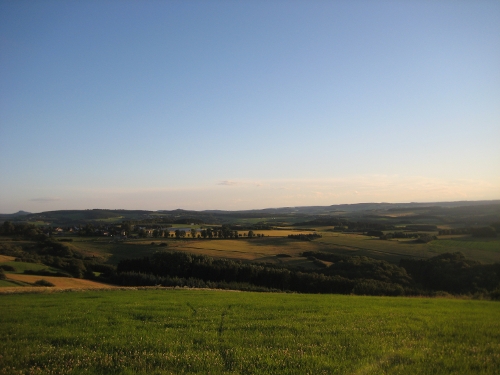
Man hat ja gelernt, seine Ansprüche zurückzuschrauben in diesen neumodischen deutschen Sommern. Aber gestern war ein Sommertag. Punkt.
I think we have learned to dampen our expectations when it comes to these strange new summers in Germany. But yesterday, it was summer. Period.
Erst ein bisschen genüssliche Gartenarbeit vor dem Besuch bei einer Freundin…
Start out with some enjoyable gardening before you move on to see a friend…
… bevor das obligatorische Barbecue gestartet wird…
… before the barbecue gets going…
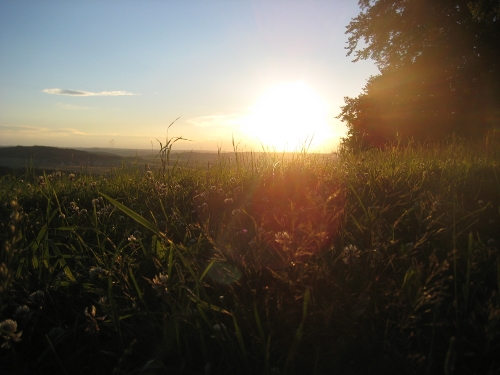
… um dann mit Vattern weiter zu ziehen auf den Dorfberg, um den Sonnenuntergang zu beobachten (den Gedanken hatten aber nicht nur wir)…
… to then take Dad to the village’s hill to watch the sun set (a thought a few more people had)…
… und dann zur Krönung bei Kerzenlicht im Garten zu sitzen und auf den Tanz der Glühwürmchen zu warten (der auch kam, pünktlich ab halb elf). Ich will mehr davon.
… and then sit in the garden by candlelight and wait for the dance of the fireflies (which did take place right on time from 10:30 onwards). I want more of this.
Es könnte stimmen: ich komme wieder in Schwung. Es ist ja nun auch schon Juli und es wird Zeit, bei der Weihnachtskartenproduktion aufzuholen. An der aktuellen Challenge bei Winter Wonderland, Monochromatic, freut mich besonders, dass ich den kleinen Filzelch unterbringen konnte, der schon ganz lange in meinem „Materiallager“ schlummert.
It could be right: I’m gaining momentum. It’s already July after all and it’s high time I caught up on my Christmas card production. The current challenge at Winter Wonderland, Monochromatic, finally put this little felt moose to good use that has been sitting in my stock for a while.
An dem verwendeten Hintergrundpapier gefällt mir besonders, dass die Ornamente alle an einem Wunsch oder weihnachtlichen Stichwort hängen:
What I like best about the background paper is that all the ornaments dangle from a sentiment or Christmas related word:
Habt eine gute Woche und verpasst das Freebie nicht!
Der gestrige Tag entwickelte sich unerwartet zu einem Haushaltstag. Die Wohnung ist sauber, ich habe ungefähr sieben Mahlzeiten gekocht und entschieden, dass es an der Zeit sei, zum ersten Mal Marmelade zu kochen. Und was liegt da näher, als Erdbeeren? Beim Chefkoch lachte mich Andis Erdbeermarmelade an… mit Amaretto und in der in den Kommentaren angeregten Variante mit Marzipan.
Yesterday turned out to be a day of household chores. The aparment is clean, I prepared about seven meals and decided it was high time to give making jam a shot. Strawberry, of course. I’d found Andi’s Strawberry Jam at chefkoch.de very appealing, with Amaretto. And there was a comment suggesting the addition of marzipan… that couldn’t be wrong!
Es war an sich überraschend einfach und schnell passiert… und ist ausgesprochen lecker! Nur ist es ein ganz kleines bisschen auf der zu leicht streichbaren, sprich flüssigen Seite geblieben. Es könnte an der großzügigen Dosierung des Amaretto gelegen haben? Aber so oder so scheint es mir ideal für die Verwendung auf frisch gebackenen Waffeln…
It was a surprisingly easy and quick thing to do as such… and it really is yummy! It only remained a tad on the liquid side after hours of letting it thicken… it might have something to do with the amaretto, come to think of it. Anyhow, it seems to be perfect for use on freshly made waffles…
Da ich selbst – außer auf Waffeln – eigentlich gar keine Marmelade esse, kam mir die laufende ABC Christmas Challenge gelegen, die da heißt: M is for Make a Gift. Ich betrachte das mal als Prototyp, denn Weihnachten wird die Marmelade, die ja ihre Farbe verliert (außerhalb eines Gefrierfachs), nicht mehr wirklich ansehnlich sein.
As I myself don’t eat much jam – other than on waffles – I was happy to see that this week’s ABC Christmas Challenge is: M is for Make a Gift. I consider it to be a prototype as the jam will certainly not be nice to look at any more once Christmas comes around as it turns all brown (if not stored in a freezer).
Also könnte man ja auch hingehen, und ein weiteres Freebie verlosen. Ja, könnte man, oder? Also gut! Ich verlose diesen Weihnachtsprototyp unter all denen, die bis Freitag, 6. Juli 2012 um 18 Uhr MESZ ein Follower geworden sind und einen Kommentar unter diesem Eintrag hinterlassen. Am liebsten einen, der mit Marmelade zu tun hat. Viel Glück!
I guess it would make a nice piece of blog candy, too, huh? Alright then! I raffle off this Christmas prototype among all those who are or have become a follower of this blog and leave a comment underneath this entry until Friday, July 6, 2012 at 6pm GMT+2. A comment on jam would be nice. Good luck!
Da war doch was… Ende Mai habe ich anlässlich des 20. Followers ein Freebie verlost – gleich mit dem Hinweis, dass sich der Vorgang wegen Urlaubs bis Ende Juni hinziehen würde. Aber nun ist es höchste Zeit. Es gab 5 Teilnehmer an der Verlosung, die uns per Kommentar mitgeteilt haben, was ihnen am Mai gefällt. Die Antworten waren vielfältig: Regen, Blumen, Maibäume für periphere Räume bedienende Damen des horizontalen Gewerbes, blühende Weißdornhecken und die vielen Feiertage. Und das ist die Gewinnerin:
What was it…? Right: at the end of May I had some blog candy to be raffled off – letting everybody know from the start that due to my vacation the actual raffle would have to wait until the end of June. But now it’s high time. There were five participants who let us know in a comment what it is they like best about the month of May. The answers were multifaceted: rain, flowers, may poles for ladies offering services in the oldest profession in remote areas, hawthorn in bloom and the many holidays [in Germany]. And this is the winner:
Herzlichen Glückwunsch, Kathrin! Bitte kontaktiere mich, damit ich den Versand der beiden Flaschen Prisecco anschieben kann. Und wenn wir nun auch am Sonntag auf nichts mehr anzustoßen haben, so wird sich doch sicher eine andere Gelegenheit ergeben…
Congratulations, Kathrin! Please get in touch so that we can discuss shipping of those two bottles of Prisecco. And even if there’s nothing to toast to anymore on Sunday (reference to Germany’s defeat against Italy at the European Soccer Championships last night), I’m sure there will soon be another occasion…
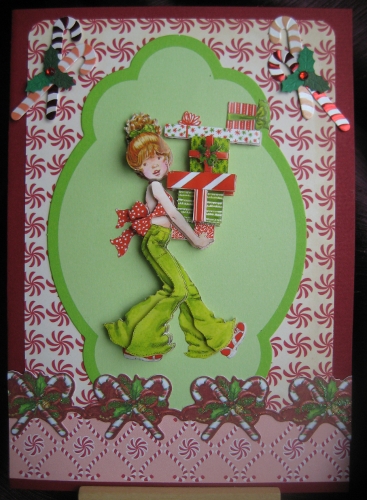
Nach langer Abwesenheit aus meiner Bastelecke versuche ich nun wieder, in Fahrt zu kommen – die Weihnachtskartenproduktion hängt hinterher. Nichts besser also, als sich mal wieder unter den Challenges umzutun. Bei Winter Wonderland sind in dieser Woche Candy Canes gefragt.
After a prolonged absence from my creative nook I am now trying to gain momentum again – I’m way behind with my Christmas cards. Nothing better than a challenge, I thought, and found out that Winter Wonderland is all about Candy Canes this week.
Ja, eventuell sind mir da ein paar Candy Canes ausgerutscht… aber wenigstens kann mir keiner Subtilität vorhalten 😉
Yes, maybe I’ve overdone it a bit on the candy canes… but this way nobody can blame me for being subtle, I guess 😉
Barbara
P.S.: Nicht verzagen: ich bin noch lange nicht durch mit den Reiseberichten…
P.S.: Do not despair! I’m far from done with the travel posts…
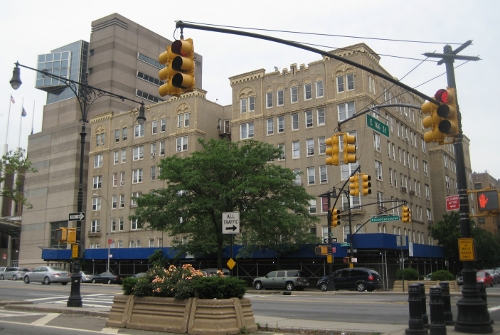
Vor dem Besuch in der Bronx haben wir ja ähnlich gezittert, wie vor dem in Harlem 😉 – und dann war das auch noch am gleichen Tag! Aber, oh Wunder: wir haben uns auf den Grand Concourse konzentriert, einer den Champs Elysées nacheifernden Prachtstraße, die uns erneut die Architektur des Art Déco näherbrachte.
The thought of touring the Bronx was about as scary as that of Harlem 😉 – and we even did it on the same day! But, would you believe it: we concentrated on the Grand Concourse, a fancy boulevard which was modeled on the Champs Elysées in Paris and was all about Art Déco.
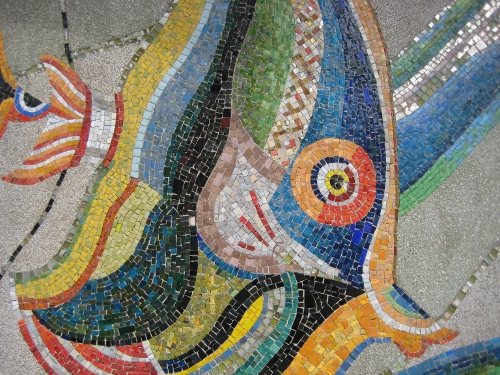
Zum Baubeginn 1894 war dort ja sozusagen grüne Wiese und der Boulevard konnte noch großzügiger gestaltet werden, als das französische Vorbild: er ist 6km lang und bis zu 55m breit. 1909 wurde er dann für den Verkehr geöffnet und ein Bauboom setzte ein, der durch die Eröffnung der U-Bahn 1917 weiter in Schwung kam. Unter den ca. 300 Appartmenthäusern gibt es einige der bedeutensten Beispiele des Art Déco in den USA zu sehen – aber irgendwie sprang der Funke bei mir trotz wunderbarer Mosaike wie an der Außenwand unten nicht über.
Construction started in 1894 and as this area was practically out in the countryside at the time, there was room to create a boulevard that surpassed even the French example it was modeled after: it is 6km/4 miles long and up to 55m/180 feet wide. It was opened to traffic in 1909 and initiated a housing boom which was further intensified after the opening of a subway station close by in 1917. Among the approximately 300 apartment buildings along the Grand Consourse there are some of the most exquisite examples of Art Déco in the US. But somehow it didn’t ignite a spark for me, despite gorgeous mosaics on the walls of houses like the one below.
Vielleicht war es der graue Himmel oder aber die paar Geschichtsfetzen, die man als gemeiner Mitteleuropäer im Zusammenhang mit der Bronx im Kopf hat. Nach einem extremen Bevölkerungszuwachs Anfang des 20. Jahrhunderts (1900: 200.000 Einwohner, 1929: 1,3 Millionen), verursacht durch das erste „Überschwappen“ von hauptsächlich italienischer, irischer und jüdischer Bevölkerung aus Manhattan, erlebte das Stadtviertel zwischen 1950 und 1980 einen Niedergang.
Maybe it was the gray sky or those few isolated facts the common central European has heard about the Bronx. It underwent a breathtaking population growth at the start of the 20th century (1900: 200,000 inhabitants, 1929: 1.3 million) which was caused by the first population spillover from Manhattan of mainly Italian, Irish and Jewish backgrounds. The decline of the borough started in the 1950s and went through about 1980.
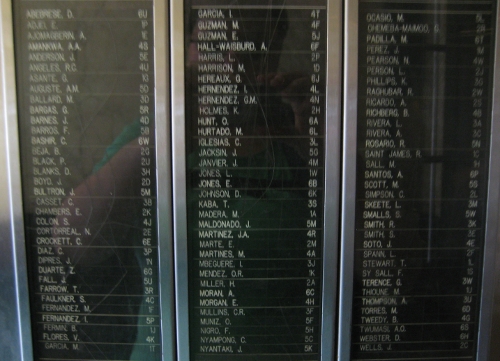
Besonders die South Bronx war davon betroffen und ist durch Unruhen in den 1970er und 80er Jahren und den damit verbundenen großflächigen Bränden zu trauriger Berühmtheit gelangt. Bis heute ist nicht klar, ob das Abfackeln ganzer Straßenzüge nicht (auch) durch die Eigentümer gestartet wurde, deren Mieteinnahmen unter die zu zahlende Grundsteuer gefallen waren… und die sich vielleicht des Problems durch eine Zahlung der Versicherung entledigen wollten. Heute ist der Stadtteil stark differenziert. Während im Norden gehobene Wohngegenden zu finden sind, bleibt der Süden eine Problemzone. Ob die Bevölkerung tatsächlich näherungsweise 10% weiß, 50% Hispanic, 30% schwarz und 10% asiatisch ist, habe ich an einem „Klingelschild“ festzustellen versucht:
The South Bronx in particular was affected by this and has become notorious for the riots of the 1970s and 80s and the large fires that it experienced during that time. To this day it is unclear how the fires started. One theory is that landlords did it as at some point property tax exceeded incomes… and maybe this was a way of solving that problem – getting an insurance payment at least. Today there are huge differences within the Bronx. While a more affluent population lives in the North, the South remains a problem area. I’ve tried to verify whether the population really is approximately 10% White, 50% Hispanic, 30% African-American and 10% Asian by analyzing a doorbell panel:
Nehmen wir mal, der besseren Leserlichkeit wegen, die mittlere Spalte: Garcia – Guzman – Guzman – Hall-W. – Harris – Harrison – Hereaux – Hernendez – Hernendez – Holmes – Hunt – Hurtado – Iglesias – Jacksin – Janvier – Jones – Jones – Johnson – Kaba – Madera – Maldonado – Martnez – Marte – Martines – Mbguere – Mendez – Miller – Moran – Morgan – Mullins – Muniz – Ngao – Nyampong – Nyantang. 34 Parteien, davon mit großer Wahrscheinlichkeit 15 mit hispanischem Hintergrund. Das sind knapp 50%. Bei den letzten dreien vermute ich asiatischen Hintergrund… knapp 10%. Kann man bei Kaba vielleicht auf die um den Grand Concourse konzentrierte ghanaische Community tippen? Ist Jacksin ein Tippfehler? Fragen über Fragen…
Let’s have a look at the second column, just for the sake of somewhat enhanced legibility: Garcia – Guzman – Guzman – Hall-W. – Harris – Harrison – Hereaux – Hernendez – Hernendez – Holmes – Hunt – Hurtado – Iglesias – Jacksin – Janvier – Jones – Jones – Johnson – Kaba – Madera – Maldonado – Martnez – Marte – Martines – Mbguere – Mendez – Miller – Moran – Morgan – Mullins – Muniz – Ngao – Nyampong – Nyantang. 34 parties, 15 of which are very likely to have a Hispanic background which is a little less than 50%. The last three have an Asian ring to me – a little less than 10%. Could Kaba be a member of the Ghanaian community that is said to be concentrated on Grand Concourse? Is Jacksin a typo? Questions galore…
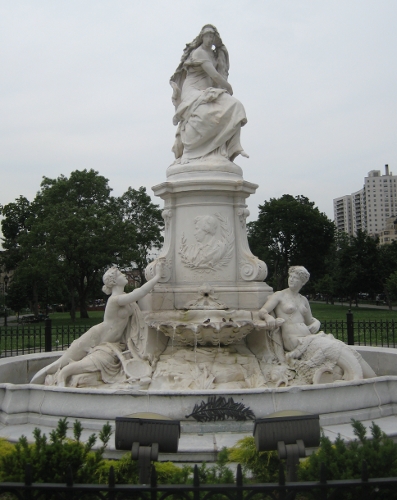
Aber vielleicht konnte ich mich ja auch gar nicht so recht auf Art Déco konzentrieren, weil der Ausgangspunkt für unsere Erkundung der Bronx ein Brunnen im Joyce Kilmer Park war. Die sog. Loreley Fountain. Oder auch… das Heinrich-Heine-Denkmal. Ja, ein Heine-Denkmal in der Bronx. Die wenigsten New Yorker kennen diesen Brunnen und ob überhaupt einer weiß, wer Heinrich Heine ist bzw. war…?
But maybe there is a whole other reason that distracted me from all the Art déco. We started our walk on Grand Concourse at a fountain in Joyce Kilmer Park. The so-called Loreley Fountain which is a monument to Heinrich Heine. Now, how many New Yorkers know that this fountain exists? And how many know who Heinrich Heine is or rather was…? You can’t find all that much English language information on it when you google… but it does have a Facebook page! Though also in German and „liked“ by two people so far 😉 And for the record: he was a German poet!
Das Denkmal wurde 1897 durch den Bildhauer Ernst Herter fertiggestellt, der es zum 100. Geburtstag des Dichters dessen Geburtsstadt Düsseldorf anbot. Dort jedoch entschied man sich, dass einem Juden kein Denkmal zu setzen sei (seit 1965 haben sie immerhin eine Uni in seinem Namen – also zumindest lernfähig). Dies wiederum kam der deutsch-amerikanischen Gemeinde zu Ohren, die das Denkmal nach New York holte und dort 1899 errichtete. Offensichtlich ist es ein Vertreter dieser Community, der die Geschichte hier nochmal referiert und außerdem Die Loreley zum besten gibt:
The monument was finished in 1897 by sculptor Ernst Herter who offered it to Heine’s native city of Düsseldorf on the occasion of the poet’s 100th birthday. The city declined as nobody wanted to erect a monument for a Jew (today they have Heinrich Heine University, established in 1965, so we can at least state that they do learn. After a while.) The German-American community heard about this and decided that New York was a great place for the monument where it was erected in 1899. I assume it’s a representative of that community who gives us all the details of it and then recites the poem The Loreley in the (German language) video below:
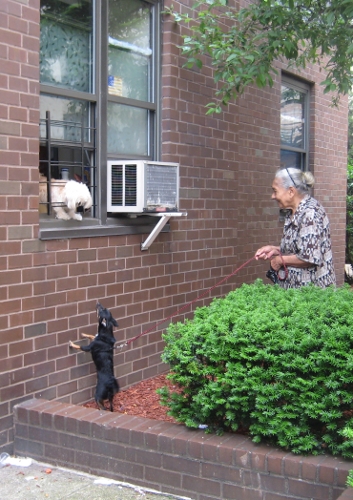
Zum Abschluss noch dieses Foto aus den Roosevelt Gardens, einer Art Gated Community in der Bronx, wo wir uns mal kurz im beschaulichen Innenhof umsehen durften.
Before I sign off for today, there’s one more picture from Roosevelt Gardens, a gated community in the Bronx, where we were allowed to have a short break in their serene courtyard.
Der Chelsea Market im Meatpacking District ist im Erdgeschoss der ehemaligen National Biscuit Company entstanden. Es handelt sich um eine Ansammlung qualitativ hochwertiger Restaurants und Geschäfte, die sich durch dieses alte Fabrikgebäude ziehen, dessen industrieller Charme erhalten bzw. durch Installationen aufgenommen wurde. An einer Stelle wurde er auch als postindustrieller Themenpark bezeichnet.
Chelsea Market in NYC’s Meatpacking District was created on the ground floor of the former National Biscuit Company. It houses a collection of high quality restaurants and stores that meander through the ground floor of this old manufacturing site. The industrial hertitage was preserved and highlighted in artistic installations. I also found it called a postindustrial theme park.
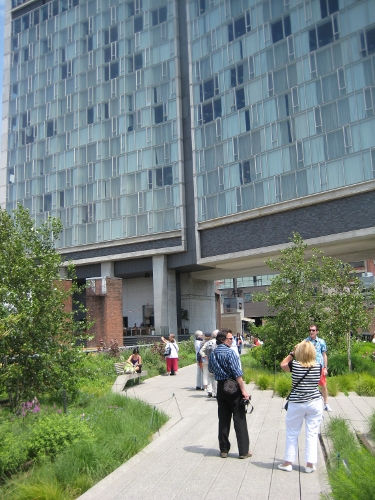
Von dort ging es weiter zum High Line Park – dem Ziel, das ich als einziges als Muss für meinen Besuch definiert hatte. Von 1934 bis 1980 wurde über diese Schienenverbindung Fleisch zum Meatpacking District, landwirtschaftliche Erzeugnisse zu Fabriken und Post zum Postamt geliefert.
We then moved on to the High Line Park – the only destination I had defined as a must-see prior to leaving for the trip. It’s an old freight rail line which was in operation from 1934 to 1980, delivering meat to the Meatpacking District, agricultural goods to the factories and mail to the Post Office.
Ursprünglich war die High Line 21 km lang; der heutige Park umfasst 2,33km, der in zwei Abschnitten angelegt und 2009 bzw. 2011 eröffnet wurde. Es gibt noch einen dritten Abschnitt, dessen Zukunft allerdings noch unklar ist.
The High Line originally covered 13 miles; today’s park spans 1.45 miles, which was created in two sections which were opened to the public in 2009 and 2011 respectively. A third section remains but what the future holds for it is unclear.
Die High Line sollte abgerissen werden. 1999 jedoch gründeten zwei Anwohner die Bürgerinitiative Friends of the High Line zur Erhaltung der Hochtrasse, die, wie man sieht, sehr erfolgreich war.
The High Line was scheduled for demolition. But in 1999 two neighborhood residents founded Friends of the High Line, a non-profit that fought to preserve the line – quite successfully, as you can tell.
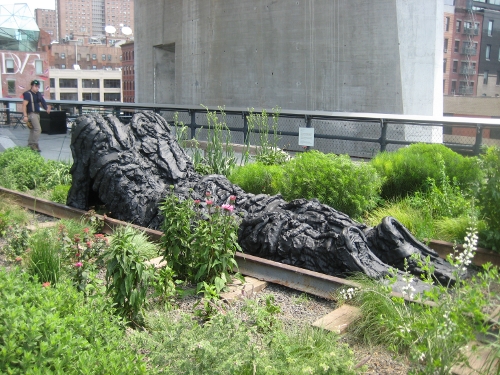
Hier und da sind noch Schienenstränge erhalten, die auf verschiedenste Art und Weise in das Park-Design integriert wurden.
There are some leftover tracks here and there, which have been inlcuded in the park design in a number of different ways.
Das viele Grün und die Blumen so nah an bzw. mitten in der Bebauung haben mich fasziniert.
All the green and the flowers so close to or practically as part of the built environment were fascinating.
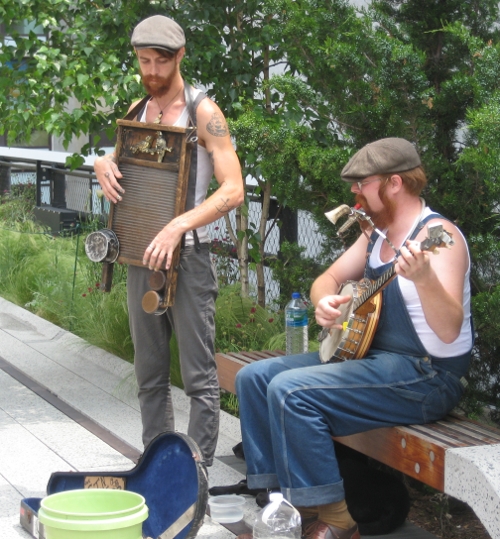
Die zwei Jungs haben ordentlich Stimmung gemacht und suchen Zuwachs. Interessierte „red heads“ sind herzlich willkommen. 😉
These two guys pleased the crowds with their upbeat performance – and are looking for an addition to their team. If there are any „interested red heads“ they are welcome to drop by. 😉
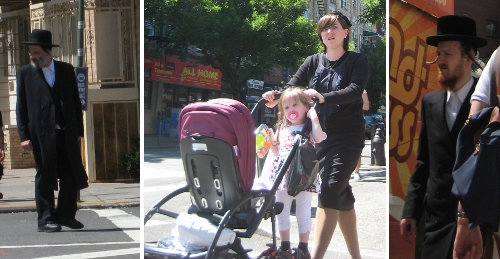
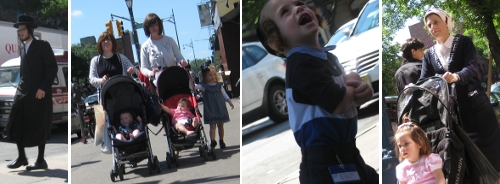
Einem Kulturschock gleich kam unser Besuch in der Lee Avenue in Williamsburg (gehört zu Brooklyn). Mittlerweile habe ich verschiedene Quellen aufgetan, deswegen ist es etwas schwierig, sich auf eine Zahl festzulegen: dort leben zwischen 45.000 und 70.000 Mitglieder der ultraorthodoxen jüdischen Glaubensrichtung der Hasidim, hauptsächlich der Satmar Hasidim, benannt nach der Stadt Satu Mar in Ungarn.
I think it’s safe to say that we were suffering from culture shock when visiting Lee Avenue in Williamsburg (part of Brooklyn). In the meantime I have unearthed different sources so it’s kind of hard to decide on the population size: between 45,000 and 70,000 followers of the ultraorthodox Jewish community of the Hasidim, mainly the Satmar Hasidim, named after the town of Satu Mar in Hungary, live in Williamsburg.
Die Hasidim unterteilen sich in viele Untergruppen, darunter z.B. auch die Bobover and Lubavitch Hasidim, die ihre Zentren jeweils in Boro Park und Crown Heights haben. Die Satmar Hasidim, die eine vehement anti-zionistische Einstellung vertreten, werden als strikteste Gruppe angesehen. Die Frauen bspw. rasieren sich das Haupthaar und tragen Kopftücher (andere bevorzugen Perücken… die alle gleich aussehen). Siehe u.a. dazu hier.
Mit dem Fotografieren habe ich mich etwas schwer getan und ausschließlich „aus der Hüfte geschossen“. Aber vielleicht kommt auch so etwas vom wenig bunten Treiben rüber – die Kinderwagendichte war extrem, vielleicht deswegen auch die unterschiedlichen Bevölkerungszahlen. Die müssen auf jeden Fall in einem exponentiellen Anstieg begriffen sein. Das folgende Video habe ich auf youtube gefunden. Ein Nicht-Hasidim hat Feierlichkeiten in seiner Nachbarschaft in Williamsburg dokumentiert. Interessant sind auch die Kommentare dazu, die die Einstellung des „Mainstream“ gegenüber dieser Gemeinschaft wiederspiegeln.
I had a hard time taking pictures and took all of them with the camera dangling at hip height. But maybe you can still get an idea of the not very colorful hustle and bustle on the street. The stroller density was extremely high – maybe that is part of the reason why the population numbers differ because they must be on an almost exponential rise. I’ve found the following video on youtube. A non-Hasidim has documented some celebration in his neighborhood in Williamsburg. The comments are also quite interesting in that they reflect how „mainstream America“ views this community.
Der folgende Soundwalk zeigt mehr vom Alltag:
The following Soundwalk shows more of daily life:
Wir haben uns schon auch gefragt, wie sich eine derart andere Lebensweise so lange so intensiv halten kann – und das in einem Umfeld, wo man mit unzähligen Lebensentwürfen jedweder Art quasi bombadiert wird. Einerseits scheint es irgendwie „sinnvoller“, sich wie die Amish im ländlichen Pennsylvania abzukapseln, andererseits ist es aber vielleicht auch gerade die Vielfältigkeit New Yorks, die Toleranz für solche Extreme ermöglicht. Dazu die Frage, ob die jungen Leute da nicht ausbrechen wollen. Wie sich herausstellt, gibt es dazu eine im Februar diesen Jahres erschienene Autobiographie von Deborah Feldman:
We did wonder how a way of life so different can be upheld for such a long time in an environment that is teeming with lifestyles of all kinds. On the one hand, it seems to make more sense to encapsulate yourself in rural Pennsylvania as the Amish do, on the other hand, maybe it is just the very diversity of NYC that allows a tolerance for such extremes. And of course we wondered whether young people weren’t trying to break out. As it turns out, the memoir of Deborah Feldman on just this subject was published in February this year:
Oprah hat sich auch in mehreren 45-minütigen Dokumentationen mit den Hasidim Gemeinschaften beschäftigt – leider sind diese Videos in Deutschland nicht abrufbar. Dafür bin ich über den Film A Life Apart gestolpert – eine 90-minütige Dokumentation der verschiedenen Gruppen in New York. Ich habe ihn mal bestellt.
Oprah also did several 45-minute documentaries on the Hasidic communities – these videos are not available to users in Germany so I pass on linking them up here. But I’ve also come across a 90-minute documentary called A Life Apart that portrays the different communities in NYC. I’ve ordered it so we will see.


























 The Knackered Grouse