Negombo: Hochseefischen / Game fishing

NG2_1
Wo sich die Gelegenheit bietet, haben wir auch mal das Hochseefischen (?) ausprobiert. Der Anbieter unseres Vertrauens war Game Fishing (Pvt.) Ltd. hier in Negombo. Ich war darauf aus, so einen 222kg Bluefin Tuna an Land zu ziehen, der auf irgendeinem Fischmarkt 1,8 Millionen Dollar eingebracht hat. Wobei ich da auch bitte gerne noch die Erklärung hätte, wie es zu diesem Preis kommt. Es kann ja dabei nicht um Nahrung gehen. Und nicht, dass ich jemals zuvor auch nur mal eine Angel in der Hand gehalten hätte.

Now that we had the opportunity, we gave game fishing a try. We decided on the services of Game Fishing (Pvt.) Ltd. here in Negombo. I was going for a 222kg bluefin tuna that fetched USD 1.8 million on some fish market recently. For which, by the way, I still need an explanation – this can’t be about food. And not that I had ever even held a fishing rod before.

Traditioneller Katamaran / Traditional catamaran

Traditioneller Katamaran / Traditional catamaran

Was wir also unternahmen, war die Jagd auf Raubfische und die fängt man indem man „trollt“. Das heißt, man fährt weit raus, in dem Fall die gefühlte halbe Strecke Richtung Indien, schmeißt die Leine raus und fährt weiter, kurvt also für den Laien eher wahllos im Indischen Ozean rum – aber der Kapitän wusste schon ganz genau, wo wir waren. Und seit ich heute im National Geographic las, dass der polynesische Priester Tupaia anno 1769 mit James Cook im Pazifik unterwegs war und immer und überall ohne technische Hilfsmittel sagen konnte, wo Tahiti liegt, erscheint das möglich.

So what we did was go for predators – and now there’s no guarantee I find the right English vocabulary, please bear with me and be imaginative – by so-called „trolling“. That means you go out, as I felt about half the way to India, cast the line and keep going aimlessly (as it felt for a layman like me) across the Indian Ocean. But of course our captain always knew precisely where we were. And now that I’ve read in the current National Geographic Magazine that the polynesian priest Tupaia, sailing with James Cook in 1769, „amazed the sailors by pointing on request, at any time, day or night, cloudy or clear, precisely toward Tahiti“ I believe it is possible.

NG2_5

Auch wenn der einfache Weg, die Lage des zweiten Riffs vor Negombo festzustellen, das Erreichen des Maschinenblocks (9 Zylinder!) eines vor Jahren dort aufgelaufenen Frachters ist…

The easy way of telling where the second reef off the coast of Negombo is located, though, is to find the engine block (9 cylinders!) of a freighter that ran aground there a few years ago…
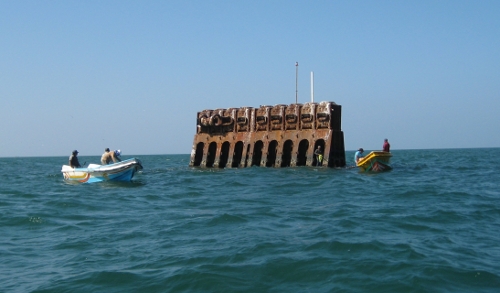
NG2_6

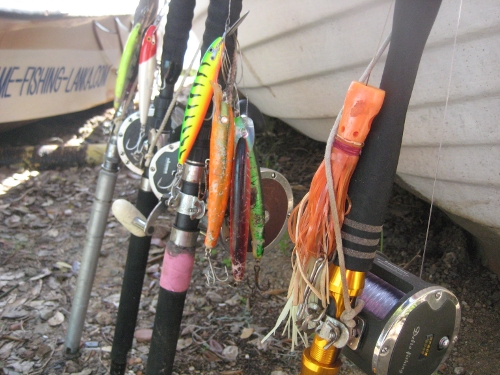
Neben dem Handling der Angel und diversen anderen Equipments habe ich außerdem in Erfahrung bringen können, dass wir keinen Köder benutzt haben, sondern Lure. Das sind keine Synonyme: Köder sind natürlich (wenn meist auch tot), Lure sind sozusagen Plastikköder (siehe auch erstes Foto). Die werden 100 bis 200 Meter hinterhergezogen – was dann auch meine Frage beantwortete, warum die Fische es bei dem lauten Motorgeräusch nicht rallen, dass sie verarscht werden. Zu weit weg.

I learned some on handling the fishing rod and other equipment and also understood that we were not fishing with bait but lure. These are not synonyms, mind you. Bait is natural (though sometimes dead), lure is basically plastic bait (see first picture). They are on a line of 100 to 200 meters – which also answered my question why the fishes get fooled when there’s an engine running. Too far away.

Dieser "Bau" aus Zweigen wird in der Lagune aufgestellt, damit Fische drin "wohnen" und einfach abgefischt werden können / This contraption of branches is put up in the lagoon for fishes to live in - and subsequent easy fishing

Dieser „Bau“ aus Zweigen wird in der Lagune aufgestellt, damit Fische drin „wohnen“ und einfach abgefischt werden können / This contraption is put up in the lagoon for fishes to live in – and subsequent easy fishing

Wir waren ungefähr 5 Stunden mit fischen beschäftigt, in praller Sonne, die Gischt im Gesicht… und waren letztlich so wahnsinnig erfolgreich (kein Fang…), dass sich ein Fisch erbarmte und an Bord sprang. Das Barbecue am Abend musste jedoch anderweitig ausgestattet werden.

We were seriously fishing for about 5 hours, in scorching sun, spray in our faces… and ended up being so incredibly successful (no catch…), that a fish showed mercy and jumped onboard. That night’s barbecue needed to be supplied through other sources, though.

Unser Fang / Our catch

Unser Fang / Our catch

Der geruhsame und ruhigere Teil folgte dann noch auf dem etwa zweistündigen Rückweg. Wir hatten mittlerweile fast die Höhe von Colombo erreicht und bogen ein in einen der vielen von den Holländern gebauten Kanäle, auf dem wir geruhsam bis zur Lagune tuckerten und uns dann dem Hohn und Spott der Fischer in der Nachbarschaft aussetzten…

The slow and more serene part was to follow on our two-hour return trip. We had gotten to just north of Colombo already and entered one of the many canals built by the Dutch on which we slowly progressed to the lagoon to then receive a fair share of laughter from the fishermen of the neighborhood…

NG2_7

Maritime Tsunami-Opfer und Beispiel einer Spende / Maritime tsunami victims and sample of a donation

Maritime Tsunami-Opfer und Beispiel einer Spende / Maritime tsunami victims and sample of a donation

Ich muss ja sagen, dass mir nicht wirklich nach dem kulturellen Teil der Reise ist, der nun ansteht. Ich glaube, ich hätte auch drei Wochen in Negombo verbringen können, vielleicht mit dem einen oder anderen Tagesausflug, und hätte nicht das Gefühl gehabt, dass ich was verpasse. Aber lassen wir die Zahnterrassen, Höhlentempel und Teeplantagen mal auf uns zukommen.

I have to say that I don’t really feel like starting the cultural part of our trip that’s coming up now. I think I could easily have stayed in Negombo for three weeks, maybe doing a day trip or two and wouldn’t have felt I had missed out on something. But let’s see what all the tooth terraces, cave temples and tea plantations have in store for us.

Barbara
Negombo: Nachbarschaft / Neighborhood

NG1_1
In Deutschland waren wir wegen des „Schneechaos“ zwar ziemlich verspätet losgekommen, sind aber dann trotzdem in Sri Lanka bestens angekommen. Am Flughafen wurden wir dann auch gleich von unserem Freund Klaus in Empfang genommen. Der wohnt mit seiner Frau Iko in Negombo, wo wir dann auch die ersten Tage verbringen werden.

Our departure from Germany was a bit delayed due to the snow chaos (yes, I do hear you laugh, Gail!) but we made it to Sri Lanka alright. Our friend Klaus welcomed us at the airport and took us home to Negombo, where he lives with his wife Iko. And this is where we will spend the first couple of days.

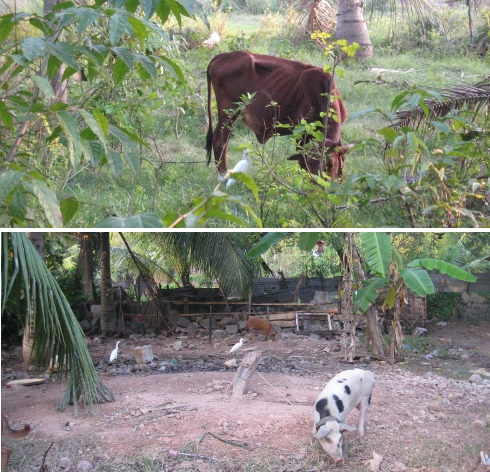
In der Nachbarschaft / In the neigborhood

In der Nachbarschaft / In the neigborhood

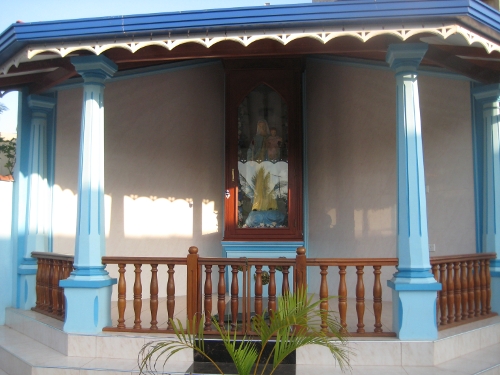
Negombo ist eine (wie mir scheint) ausufernde Lagunenstadt – überall Wasser, Brücken, Mangroven. Man sollte meinen, dass sie im Reiseführer als „Venedig Sri Lankas“ vorgestellt wird, aber es heißt „Rom Sri Lankas“. Und das liegt daran, dass sie zu gut 90% katholische Einwohner hat und dementsprechend über eine große Anzahl von Kirchen verfügt. Mit den Kirchen haben wir uns nicht so eingehend beschäftigt, aber an jeder Ecke steht ein größerer oder kleinerer Schrein. Anfangs habe ich nur welche mit Marienfiguren gesehen, aber es werden auch andere, erstmal nicht näher zu identifizierende Heilige verehrt.

Negombo is a city that’s sprawling on the Negombo Lagoon – water, bridges and mangroves as far as the eye can reach. You would think that the guide refers to it as „Venice of Sri Lanka“ but in fact it’s called „Rome of Sri Lanka“. That’s because it’s about 90% Catholic and features a large number of churches. We didn’t check those out but there’s a shrine dedicated to one saint or another on just about every street corner. First I thought they were all for the Virgin Mary but it turns out that there are different saints that I didn’t succeed to identify.

NG1_10

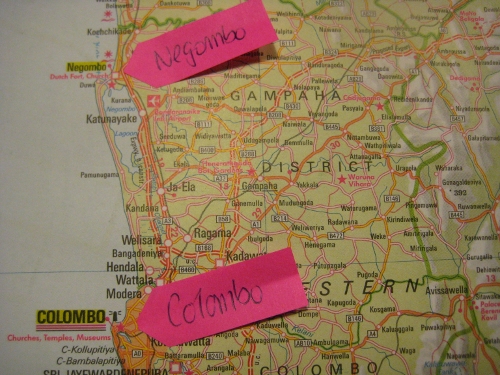
Da Negombo außerdem eine Stadt der Fischer ist, könnte man ja den Schutzpatron dieser Berufsgruppe vermuten, aber da bin ich nicht sicher. Jedenfalls wohnen wir in einem „Fischerviertel“ an der Lagune (also auf diesem langen dünnen Stück Land südlich von Negombos Zentrum, das man oben auf der Karte sieht, der Lagune zugewandt) und waren auch gleich beim Nachbarn gegenüber, Susanthe, und seiner Familie zum Essen eingeladen. Es galt die erste Menstruation seiner Tochter zu feiern.

As Negombo is a city of fishermen maybe you would expect their patron saint to feature in these shrines but I couldn’t verify that. Anyhow, we live right in the middle of a neighborhood of fishermen right on the lagoon (which means on that narrow stretch of land to the south of Negombo’s center, on the side facing the lagoon – check out the map above) where we already had our first invitation for lunch over at the neighbor Susanthe’s house. The occasion was to celebrate his daughter’s first menstruation.

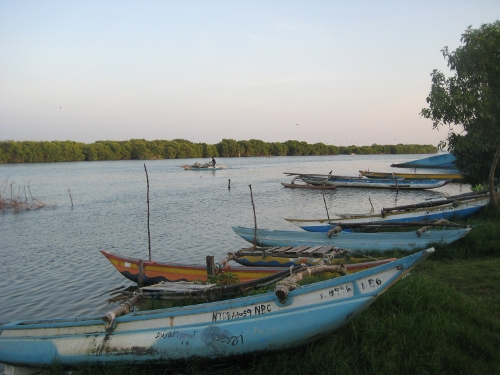
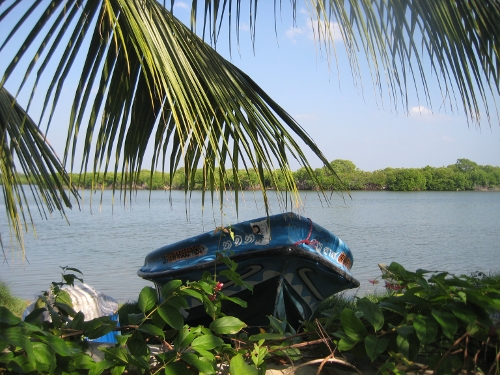
Fischerboote der Nachbarn / The neighbors' fishing boats

Fischerboote der Nachbarn / The neighbors‘ fishing boats

Fotos habe ich dort keine gemacht, aber das Haus fand ich in seiner Bauweise sehr interessant. Eine Grundfläche von vielleicht 10x6m ist am einen Ende über die gesamte Breite ca. 3m für die Küche abgetrennt. Der Rest Raum ist durch eine ca. 2,50m hohe Wand in der Mitte geteilt. Auf der einen Seite, mit Tür zur Küche, ist das Wohn- und Esszimmer, auf der anderen Seite ist nochmal eine Unterteilung in zwei Schlafzimmer. Aber da ist keine Decke eingezogen, darüber kommt der Dachstuhl und man sitzt quasi direkt unter den Dachpfannen. Was den Vorteil hat, dass die warme Luft nach oben steigt. Wo es ggf. sanitäre Anlagen gibt, weiß ich nicht. Die Innenwände waren unverputzt, dafür gab es neben Möbeln auch einen Flatscreen Fernseher. Und wenn ich so darüber nachdenke, wären das so auch meine Prioritäten, wenn ich mich entscheiden müsste (also ob Putz oder Fernseher… oder DSL!).

I didn’t take any pictures but I had a great time checking out the design of the house. It covers an area of about 10×6 meters and at one end there’s the kitchen over the complete width of 6 meters, and maybe a length of 3 meters. The rest is divided smack in the middle by a wall that’s maybe 2,50 meters high. The side with the door to the kitchen features the two-in-one dining- and livingroom, the other side is again subdivided into two bedrooms. But there is no ceiling – you’re sitting right underneath the roof construction which has the advantage that the heat can rise up and not stay so much where you are. Where there’s a bathroom or anything like that I didn’t get to figure out. The walls inside were not plastered but there was furniture and a flatscreen TV. Come to think of it – if I had to make that choice (between plaster and TV… or DSL!) I would probably end up with exactly that.

Herstellung von Trockenfisch / Laying out fish to dry

Herstellung von Trockenfisch / Laying out fish to dry

Ebenfalls interessant war natürlich das Essen. Da war zuerst mal der Ablauf überraschend. Hier gibt es nämlich sozusagen Appetizer mit Drinks („bites“). Die hätte ich schon für eine volle Mahlzeit halten können, gebratene Fische, einen Kichererbsensalat, eine Art Auberginenpfanne mit getrockneten kleinen Fischen und Kokosnote (werde ich mal nachzukochen versuchen). Und zu meiner Überraschung kam DANACH dann das eigentliche Essen.

Of course the food was also bound to be interesting. First of all, the course of events was somewhat surprising – I wasn’t expecting this to start out with appetizers („bites“) and drinks. I would have considered those a whole meal if I hadn’t been informed differently: grilled fish, a salad of the peas that hummus is made of (don’t have a dictionery at hand), an eggplant dish with tiny dried fishes and a hint of coconut (I will try to cook that at home). Only after all that was it time for the actual lunch.

Jungs beim Cricketspielen / Boys playing cricket

Jungs beim Cricket / Boys playing cricket

Da ich ja so gut wie gar nicht scharf essen kann, war ich mit ein bisschen Sorge hierhin gekommen und so ein nicht auf die europäische Zunge angepasstes Essen ist natürlich eine ziemliche Herausforderung. Dachte ich. Aber falsch gedacht. Bis auf einen feuerspeienden Chinakohl konnte ich alles essen – und ich hätte gar nicht aufhören wollen. Wieder Fisch, diesmal gekocht, Reis, eine Shrimps-Variation, Reis, Curry-Kartoffeln, Reis, eine Art Schweinegulasch, Reis, eben jener Chinakohl – und hatte ich Reis erwähnt?

As I really can’t eat anything too spicy I was a little worried and when a meal is not really „softened“ to meet the needs of my rather boring German palate, this could be a real challenge. Or so I thought. There was just one cabbage dish I could not eat – with all the rest I didn’t know where to start or stop. Fish again, cooked this time, rice, a shrimp dish, rice, curry potatoes, rice, a sort of pork gulash, rice and the abovementioned cabbage – did I mention rice?

Unbekannte Fischer bei der Reparatur der Netze / Unknown fishermen repairing their nets

Unbekannte Fischer bei der Reparatur der Netze / Unknown fishermen repairing their nets

So ein Festmahl – dabei geht’s den traditionellen Fischern hier gar nicht so gut. Ein anderer erzählte uns, dass einerseits hier riesige Flotten an indischen und chinesischen Booten auftauchen, die alles leer fischen, und dann wurde durch eine Steuererhöhung auch noch von einem Tag auf den anderen der Sprit 40% teurer. Da geraten einige Systeme aus dem Gleichgewicht. Sie sind nun dabei, eine Art Gewerkschaft zu gründen, damit ihre Interessen besser vertreten werden können. Ob das die Fischfangflotten abhält, wage ich zu bezweifeln, besonders, da man „den großen Bruder [Indien] ja nicht ärgern darf.“

What a feast this was – especially considering the fact that the traditional fishermen are not doing well here. Another one filled us in on huge fleets from India and China that catch everything that’s moving and then a tax on gas and diesel that increased prices by 40% literally over night. That would push any system off balance in no time. They are in the process of founding a trade union to better represent their interests. I doubt, though, that this will keep the foreign fleets from coming, especially as „the big brother [India] should not be angered.“

Blick von der Terrasse / View from the terrace

Blick von der Terrasse / View from the terrace

Und dann kann man natürlich auch schnell mal von der Lagunenseite den dünnen Landstreifen durchqueren und ans offene Meer gehen. Da sieht es dann so aus:

You don’t have to stay at the lagoon of course. You can easily walk from that side to the open ocean… where you find scenery like this:

NG1_3

Und damit mache ich Feierabend wünsche ich euch allen eine gute Nacht!

And with this I call it a day and wish you all a good night!

Barbara
Das Ziel / The destination

Morgen geht es los… Und ich bin dann doch in letzter Minute noch ganz gut vorbereitet. Unglaublich, aber wahr: zum ersten Mal bin ich unterwegs, ohne dass vorher schon jede Übernachtung gebucht wäre. Gebucht sind nur die fünf Tage Strand pur und ANGEBLICH soll es dort so aussehen (passenderweise aus der Januar-Ausgabe des Magazins MERIAN):

Tomorrow we’ll take off… And amazingly enough I managed to be somewhat well-prepared after all. Would you believe it: it’s the first time ever that I travel without having booked every night ahead of time. The only thing we did book was our five days beach only and SUPPOSEDLY it looks like this there:

Strand bei / Beach near Tangalle

Strand bei / Beach near Tangalle

Der direkte Vergleich wird kommen 😉 Aber zur Einstimmung erstmal noch ein paar Worte zum Land. Es ist die kleine „Perle“ oder „Träne“ südöstlich von Indien und das ehemalige Ceylon, was den Tee-Anbau in Erinnerung ruft. Die Insel ist nicht so groß, wie man vielleicht denken würde – Bayern ist größer – und auf ihr leben ca. 21 Millionen Menschen.

I’ll make sure to take a picture for comparison 😉 But I wanted to give you a few details just so you get a better idea of the country. Sri Lanka is the „pearl“ or „tear“ to the southeast of India and is formerly known as Ceylon, of Lipton tea fame. It isn’t half as large as you would think – Bavaria is bigger… it’s about the size of West Virginia (or three times the size of Wales if that gives you a better idea) with a population of about 21 million.

Quelle / Source: wikipedia

Quelle / Source: wikipedia

Je mehr ich lese, umso mehr habe ich das Gefühl, ich hätte mich eher für drei Monate als drei Wochen entscheiden sollen. Kulturstätten, Nationalparks, Kolonialarchitektur, Bewässerungssysteme, Teeplantagen, Traumstrände… und dann schlägt mein Geografenherz ja auch noch für einen Blick auf den im Megaausbau befindlichen Hafen in Hambantota, der der größte in Südasien werden soll. Aber da das geografisch in unseren Strandaufenthalt fällt, schlägt das Herz dann wohl doch wieder schwächer 😉

The more I read, the more I think I should have planned three months rather than three weeks. Places of cultural interest, national parks, colonial architecture, irrigation systems, tea plantations, wonderful beaches… and the dormant geographer was awakened by the articles about a mega port being built in Hambantota, soon to be the biggest in South Asia. But as that is located somewhat close to where we have planned beach time, priorities do shift again after all 😉

Quelle / Source: Lonely Planet

Quelle / Source: Lonely Planet

Wenn man so mit Leuten spricht, fallen den meisten zu Sri Lanka nur zwei Stichworte ein: Tsunami und Tamil Tigers, letzteres stellvertretend für den 2009 für beendet erklärten Bürgerkrieg. Ich bin gespannt auf die vielen anderen Stichworte. Bis dann!

When you talk to people, they usually associate two things with Sri Lanka: the tsunami and the Tamil Tigers, the latter representative of the civil war which ended in 2009. I’m looking forward to checking out the many other associations that there could be. More to follow soon!

Barbara
Stippvisite in Berlin / Quick visit to Berlin

BT6
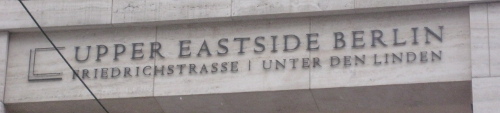
Auf dem Weg vom Hotel zur S-Bahn „musste“ ich noch nicht mal an die frische Luft. Den ganzen Rest des Tages im Berliner Ensemble verbracht. Am zweiten Tag vollkommen unkoordiniert aus einer anderen S-Bahn-Station gepoppt und zum Termin um die Ecke gegangen. Dann wieder zum Berliner Ensemble. Der Fernsehturm am Alexanderplatz im Nebel. Wie soll man da überhaupt nachweisen, dass man in der Hauptstadt war?! Also – es war kalt!

I didn’t have to set a foot outdoors to get from the hotel to the metro station. And then spent the rest of the day at Berliner Ensemble. Then on the second day just popping out of another metro station and reaching the appointment just around the corner. And back to Berliner Ensemble. The TV tower at Alexanderplatz shrouded in fog. How should I even prove that I was in our capital?! Well, it was cold!

BT2

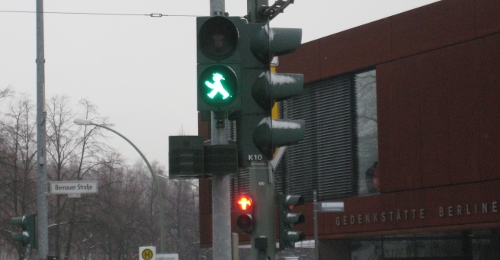
Und die Fußgängerampeln hatten diese ungewöhnlichen Männchen…

And the lights at the pedestrian crossings featured these unusual little characters…

BT3

Und zwar poppt man nur so aus einer S-Bahnstation, aber da ist sie, die Mauer. Beziehungsweise das, was von ihr übrig geblieben ist. Nicht, dass ich Zeit gehabt hätte, mir das mal alles genauer anzusehen. Ein Grund unter vielen, bald zurückzukehren. Was mir jedoch in dieser Wahnsinnsmetropole in die Finger fiel, ist das Freebie des heutigen Adventssonntags – sowas ausgeflipptes würde man ja „zuhause“ nicht bekommen:

And even if you do just pop out of a metro station, there it is: the wall – or what is left of it. One reason among many to return soon. But in this great metropolis I did come across this Sunday’s blog candy – something this flashy is hard to come by „at home“:

BT7

Für Weihnachten mag es den meisten zuviel sein, aber hier im Rheinland bietet sich ja Karneval an oder auch Halloween oder eine Motto-Party. Und dieses abgefahrene Gestell könnt ihr gewinnen, wenn ihr bis Mittwoch,19.12.2012 um 18 Uhr MEZ hier einen Kommentar dazu schreibt, welches Essen es Weihnachten geben muss, damit alles stimmt. Viel Glück!

It might be a bit much for most of you at Christmas but here in the Rhineland it could be a great accessory for carnival or Halloween or a motto party. And you can win this fancy frame by writing a comment before Wednesday, December 19, 2012 at 6pm GMT+1 – letting us know what food you just need to have on Christmas to make sure the holidays are complete. Good luck!

Barbara

Biel, Schweiz / Switzerland


Das Wetter war nicht dazu angetan, großartig touristisch aktiv zu werden. Und unser Zeitplan mit dem Besuch der Fachmesse cinfo auch nicht. Aber ein paar Fotos habe ich dann doch noch geschossen, die einen ganz guten Eindruck der pittoresken Altstadt Biels wiedergeben.

The weather truly wasn’t made for sightseeing. Neither was our agenda during this employment fair cinfo. I still managed to take a few pictures of the picturesque old city of Biel.

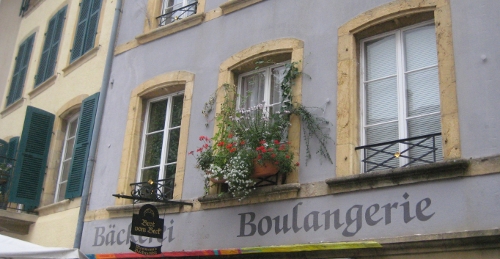
Die Stadt ist durch und durch zweisprachig – mit Deutsch oder Französisch kommt man praktisch überall weiter.

The city is bilingual throughout – you can make yourself understood with either German or French everywhere.

… auch wenn „Deutsch“ relativ sein kann. Aber ich habe auch alle schwyzerdütschen Fragen auf der Messe problemlos verstanden.

… even though „German“ can be relative. But I understood all questions posed in Swiss German at the fair without problems.

Bis zum Bieler See sind wir gar nicht vorgestoßen, aber wie gesagt ludt das Wetter auch nicht gerade zum Flanieren ein.

We didn’t even get a view of Lake Biel but then as I said: this weather wasn’t made for walking.

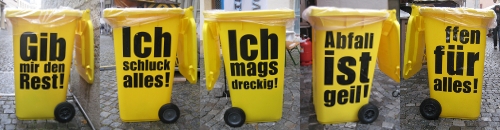
An diesem Wochenende findet auch die Bieler Altstadtchilbi statt – was sich als Straßenfest herausstellte. Im Dauerregen, bei Wind und um die 14 Grad. Da waren die interessant gestalteten Mülltonnen noch das beste Fotoobjekt (die jeweils andere Seite dann natürlich auf Französisch beschriftet).

The Old City Fest of Biel takes place this weekend as well. In pouring rain, strong winds and mabye 50F. The trash cans were among the best motifs (the picture shows German, the respective other side of the trash cans are in French. They read things like I like it dirty! or I swallow everything! or Open for everything!

Morgen früh geht’s dann wieder heimwärts. Schönes Wochenende! Und das Mitspielen um das Freebie nicht vergessen!

We’ll be back on the road again tomorrow. Have a nice weekend! And don’t forget to enter for a chance to win the blog candy!

Barbara
The Bronx


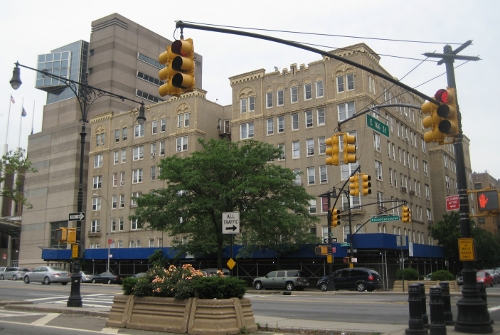
Vor dem Besuch in der Bronx haben wir ja ähnlich gezittert, wie vor dem in Harlem 😉 – und dann war das auch noch am gleichen Tag! Aber, oh Wunder: wir haben uns auf den Grand Concourse konzentriert, einer den Champs Elysées nacheifernden Prachtstraße, die uns erneut die Architektur des Art Déco näherbrachte.

The thought of touring the Bronx was about as scary as that of Harlem 😉 – and we even did it on the same day! But, would you believe it: we concentrated on the Grand Concourse, a fancy boulevard which was modeled on the Champs Elysées in Paris and was all about Art Déco.

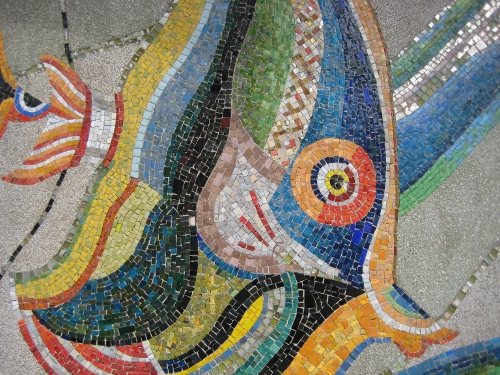
Zum Baubeginn 1894 war dort ja sozusagen grüne Wiese und der Boulevard konnte noch großzügiger gestaltet werden, als das französische Vorbild: er ist 6km lang und bis zu 55m breit. 1909 wurde er dann für den Verkehr geöffnet und ein Bauboom setzte ein, der durch die Eröffnung der U-Bahn 1917 weiter in Schwung kam. Unter den ca. 300 Appartmenthäusern gibt es einige der bedeutensten Beispiele des Art Déco in den USA zu sehen – aber irgendwie sprang der Funke bei mir trotz wunderbarer Mosaike wie an der Außenwand unten nicht über.

Construction started in 1894 and as this area was practically out in the countryside at the time, there was room to create a boulevard that surpassed even the French example it was modeled after: it is 6km/4 miles long and up to 55m/180 feet wide. It was opened to traffic in 1909 and initiated a housing boom which was further intensified after the opening of a subway station close by in 1917. Among the approximately 300 apartment buildings along the Grand Consourse there are some of the most exquisite examples of Art Déco in the US. But somehow it didn’t ignite a spark for me, despite gorgeous mosaics on the walls of houses like the one below.

Vielleicht war es der graue Himmel oder aber die paar Geschichtsfetzen, die man als gemeiner Mitteleuropäer im Zusammenhang mit der Bronx im Kopf hat. Nach einem extremen Bevölkerungszuwachs Anfang des 20. Jahrhunderts (1900: 200.000 Einwohner, 1929: 1,3 Millionen), verursacht durch das erste „Überschwappen“ von hauptsächlich italienischer, irischer und jüdischer Bevölkerung aus Manhattan, erlebte das Stadtviertel zwischen 1950 und 1980 einen Niedergang.

Maybe it was the gray sky or those few isolated facts the common central European has heard about the Bronx. It underwent a breathtaking population growth at the start of the 20th century (1900: 200,000 inhabitants, 1929: 1.3 million) which was caused by the first population spillover from Manhattan of mainly Italian, Irish and Jewish backgrounds. The decline of the borough started in the 1950s and went through about 1980.

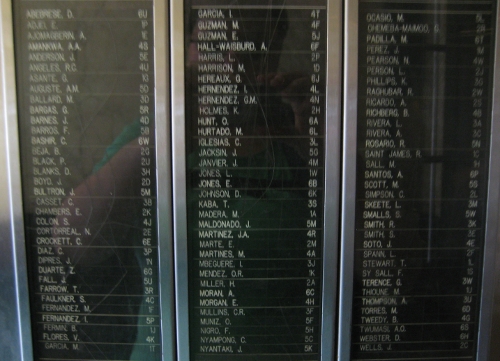
Besonders die South Bronx war davon betroffen und ist durch Unruhen in den 1970er und 80er Jahren und den damit verbundenen großflächigen Bränden zu trauriger Berühmtheit gelangt. Bis heute ist nicht klar, ob das Abfackeln ganzer Straßenzüge nicht (auch) durch die Eigentümer gestartet wurde, deren Mieteinnahmen unter die zu zahlende Grundsteuer gefallen waren… und die sich vielleicht des Problems durch eine Zahlung der Versicherung entledigen wollten. Heute ist der Stadtteil stark differenziert. Während im Norden gehobene Wohngegenden zu finden sind, bleibt der Süden eine Problemzone. Ob die Bevölkerung tatsächlich näherungsweise 10% weiß, 50% Hispanic, 30% schwarz und 10% asiatisch ist, habe ich an einem „Klingelschild“ festzustellen versucht:

The South Bronx in particular was affected by this and has become notorious for the riots of the 1970s and 80s and the large fires that it experienced during that time. To this day it is unclear how the fires started. One theory is that landlords did it as at some point property tax exceeded incomes… and maybe this was a way of solving that problem – getting an insurance payment at least. Today there are huge differences within the Bronx. While a more affluent population lives in the North, the South remains a problem area. I’ve tried to verify whether the population really is approximately 10% White, 50% Hispanic, 30% African-American and 10% Asian by analyzing a doorbell panel:

Nehmen wir mal, der besseren Leserlichkeit wegen, die mittlere Spalte: Garcia – Guzman – Guzman – Hall-W. – Harris – Harrison – Hereaux – Hernendez – Hernendez – Holmes – Hunt – Hurtado – Iglesias – Jacksin – Janvier – Jones – Jones – Johnson – Kaba – Madera – Maldonado – Martnez – Marte – Martines – Mbguere – Mendez – Miller – Moran – Morgan – Mullins – Muniz – Ngao – Nyampong – Nyantang. 34 Parteien, davon mit großer Wahrscheinlichkeit 15 mit hispanischem Hintergrund. Das sind knapp 50%. Bei den letzten dreien vermute ich asiatischen Hintergrund… knapp 10%. Kann man bei Kaba vielleicht auf die um den Grand Concourse konzentrierte ghanaische Community tippen? Ist Jacksin ein Tippfehler? Fragen über Fragen…

Let’s have a look at the second column, just for the sake of somewhat enhanced legibility: Garcia – Guzman – Guzman – Hall-W. – Harris – Harrison – Hereaux – Hernendez – Hernendez – Holmes – Hunt – Hurtado – Iglesias – Jacksin – Janvier – Jones – Jones – Johnson – Kaba – Madera – Maldonado – Martnez – Marte – Martines – Mbguere – Mendez – Miller – Moran – Morgan – Mullins – Muniz – Ngao – Nyampong – Nyantang. 34 parties, 15 of which are very likely to have a Hispanic background which is a little less than 50%. The last three have an Asian ring to me – a little less than 10%. Could Kaba be a member of the Ghanaian community that is said to be concentrated on Grand Concourse? Is Jacksin a typo? Questions galore…

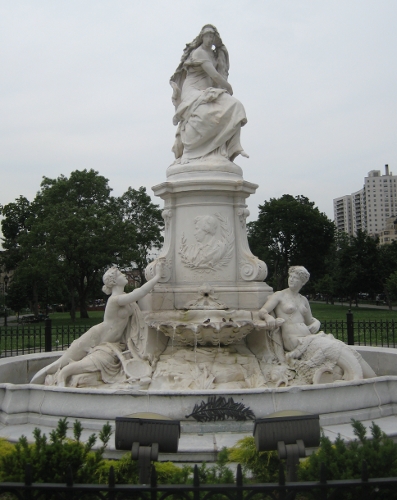
Aber vielleicht konnte ich mich ja auch gar nicht so recht auf Art Déco konzentrieren, weil der Ausgangspunkt für unsere Erkundung der Bronx ein Brunnen im Joyce Kilmer Park war. Die sog. Loreley Fountain. Oder auch… das Heinrich-Heine-Denkmal. Ja, ein Heine-Denkmal in der Bronx. Die wenigsten New Yorker kennen diesen Brunnen und ob überhaupt einer weiß, wer Heinrich Heine ist bzw. war…?

But maybe there is a whole other reason that distracted me from all the Art déco. We started our walk on Grand Concourse at a fountain in Joyce Kilmer Park. The so-called Loreley Fountain which is a monument to Heinrich Heine. Now, how many New Yorkers know that this fountain exists? And how many know who Heinrich Heine is or rather was…? You can’t find all that much English language information on it when you google… but it does have a Facebook page! Though also in German and „liked“ by two people so far 😉 And for the record: he was a German poet!

Das Denkmal wurde 1897 durch den Bildhauer Ernst Herter fertiggestellt, der es zum 100. Geburtstag des Dichters dessen Geburtsstadt Düsseldorf anbot. Dort jedoch entschied man sich, dass einem Juden kein Denkmal zu setzen sei (seit 1965 haben sie immerhin eine Uni in seinem Namen – also zumindest lernfähig). Dies wiederum kam der deutsch-amerikanischen Gemeinde zu Ohren, die das Denkmal nach New York holte und dort 1899 errichtete. Offensichtlich ist es ein Vertreter dieser Community, der die Geschichte hier nochmal referiert und außerdem Die Loreley zum besten gibt:

The monument was finished in 1897 by sculptor Ernst Herter who offered it to Heine’s native city of Düsseldorf on the occasion of the poet’s 100th birthday. The city declined as nobody wanted to erect a monument for a Jew (today they have Heinrich Heine University, established in 1965, so we can at least state that they do learn. After a while.) The German-American community heard about this and decided that New York was a great place for the monument where it was erected in 1899. I assume it’s a representative of that community who gives us all the details of it and then recites the poem The Loreley in the (German language) video below:

Zum Abschluss noch dieses Foto aus den Roosevelt Gardens, einer Art Gated Community in der Bronx, wo wir uns mal kurz im beschaulichen Innenhof umsehen durften.

Before I sign off for today, there’s one more picture from Roosevelt Gardens, a gated community in the Bronx, where we were allowed to have a short break in their serene courtyard.

Bis bald!

Take care!

Barbara
Chelsea Market & High Line Park


Der Chelsea Market im Meatpacking District ist im Erdgeschoss der ehemaligen National Biscuit Company entstanden. Es handelt sich um eine Ansammlung qualitativ hochwertiger Restaurants und Geschäfte, die sich durch dieses alte Fabrikgebäude ziehen, dessen industrieller Charme erhalten bzw. durch Installationen aufgenommen wurde. An einer Stelle wurde er auch als postindustrieller Themenpark bezeichnet.

Chelsea Market in NYC’s Meatpacking District was created on the ground floor of the former National Biscuit Company. It houses a collection of high quality restaurants and stores that meander through the ground floor of this old manufacturing site. The industrial hertitage was preserved and highlighted in artistic installations. I also found it called a postindustrial theme park.

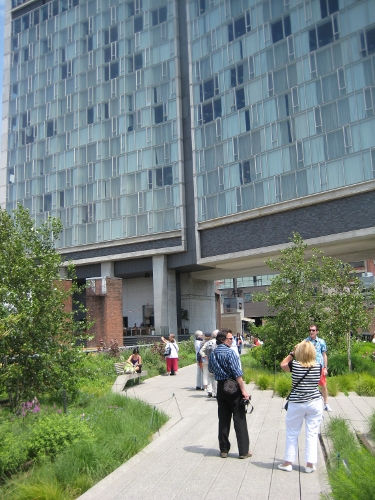
Von dort ging es weiter zum High Line Park – dem Ziel, das ich als einziges als Muss für meinen Besuch definiert hatte. Von 1934 bis 1980 wurde über diese Schienenverbindung Fleisch zum Meatpacking District, landwirtschaftliche Erzeugnisse zu Fabriken und Post zum Postamt geliefert.

We then moved on to the High Line Park – the only destination I had defined as a must-see prior to leaving for the trip. It’s an old freight rail line which was in operation from 1934 to 1980, delivering meat to the Meatpacking District, agricultural goods to the factories and mail to the Post Office.

Ursprünglich war die High Line 21 km lang; der heutige Park umfasst 2,33km, der in zwei Abschnitten angelegt und 2009 bzw. 2011 eröffnet wurde. Es gibt noch einen dritten Abschnitt, dessen Zukunft allerdings noch unklar ist.

The High Line originally covered 13 miles; today’s park spans 1.45 miles, which was created in two sections which were opened to the public in 2009 and 2011 respectively. A third section remains but what the future holds for it is unclear.

Die High Line sollte abgerissen werden. 1999 jedoch gründeten zwei Anwohner die Bürgerinitiative Friends of the High Line zur Erhaltung der Hochtrasse, die, wie man sieht, sehr erfolgreich war.

The High Line was scheduled for demolition. But in 1999 two neighborhood residents founded Friends of the High Line, a non-profit that fought to preserve the line – quite successfully, as you can tell.

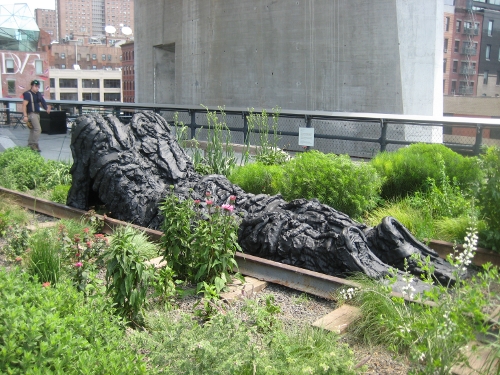
Hier und da sind noch Schienenstränge erhalten, die auf verschiedenste Art und Weise in das Park-Design integriert wurden.

There are some leftover tracks here and there, which have been inlcuded in the park design in a number of different ways.

Das viele Grün und die Blumen so nah an bzw. mitten in der Bebauung haben mich fasziniert.

All the green and the flowers so close to or practically as part of the built environment were fascinating.

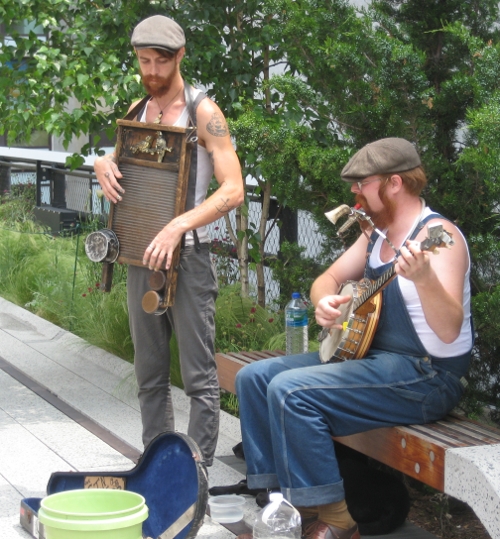
Die zwei Jungs haben ordentlich Stimmung gemacht und suchen Zuwachs. Interessierte „red heads“ sind herzlich willkommen. 😉

These two guys pleased the crowds with their upbeat performance – and are looking for an addition to their team. If there are any „interested red heads“ they are welcome to drop by. 😉

Und nun… was essen!

And now… some food!

Barbara

Unwirklich / Unreal


Einem Kulturschock gleich kam unser Besuch in der Lee Avenue in Williamsburg (gehört zu Brooklyn). Mittlerweile habe ich verschiedene Quellen aufgetan, deswegen ist es etwas schwierig, sich auf eine Zahl festzulegen: dort leben zwischen 45.000 und 70.000 Mitglieder der ultraorthodoxen jüdischen Glaubensrichtung der Hasidim, hauptsächlich der Satmar Hasidim, benannt nach der Stadt Satu Mar in Ungarn.

I think it’s safe to say that we were suffering from culture shock when visiting Lee Avenue in Williamsburg (part of Brooklyn). In the meantime I have unearthed different sources so it’s kind of hard to decide on the population size: between 45,000 and 70,000 followers of the ultraorthodox Jewish community of the Hasidim, mainly the Satmar Hasidim, named after the town of Satu Mar in Hungary, live in Williamsburg.

Die Hasidim unterteilen sich in viele Untergruppen, darunter z.B. auch die Bobover and Lubavitch Hasidim, die ihre Zentren jeweils in Boro Park und Crown Heights haben. Die Satmar Hasidim, die eine vehement anti-zionistische Einstellung vertreten, werden als strikteste Gruppe angesehen. Die Frauen bspw. rasieren sich das Haupthaar und tragen Kopftücher (andere bevorzugen Perücken… die alle gleich aussehen). Siehe u.a. dazu hier.

The Hasidim are divided into many subgroups, e.g. the Bobover and Lubavitch Hasidim in Boro Park and Crown Heights respectively. The Satmar Hasidim, „who are [v]ehemently anti-Zionist, have a reputation as the strictest sect: Satmar women, for example, shave their heads and wear a head kerchief instead of the more commonly worn wig“ (that all seemed to be of the same make).

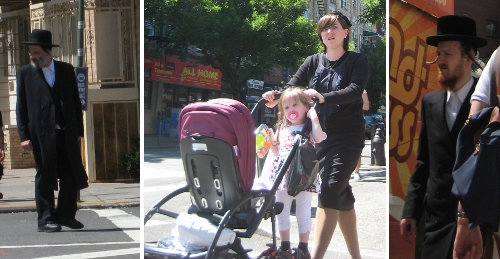
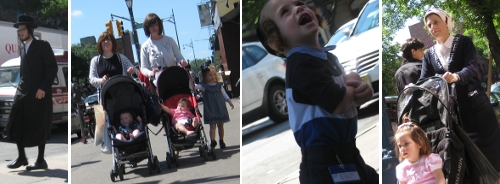
Mit dem Fotografieren habe ich mich etwas schwer getan und ausschließlich „aus der Hüfte geschossen“. Aber vielleicht kommt auch so etwas vom wenig bunten Treiben rüber – die Kinderwagendichte war extrem, vielleicht deswegen auch die unterschiedlichen Bevölkerungszahlen. Die müssen auf jeden Fall in einem exponentiellen Anstieg begriffen sein. Das folgende Video habe ich auf youtube gefunden. Ein Nicht-Hasidim hat Feierlichkeiten in seiner Nachbarschaft in Williamsburg dokumentiert. Interessant sind auch die Kommentare dazu, die die Einstellung des „Mainstream“ gegenüber dieser Gemeinschaft wiederspiegeln.

I had a hard time taking pictures and took all of them with the camera dangling at hip height. But maybe you can still get an idea of the not very colorful hustle and bustle on the street. The stroller density was extremely high – maybe that is part of the reason why the population numbers differ because they must be on an almost exponential rise. I’ve found the following video on youtube. A non-Hasidim has documented some celebration in his neighborhood in Williamsburg. The comments are also quite interesting in that they reflect how „mainstream America“ views this community.
Der folgende Soundwalk zeigt mehr vom Alltag:

The following Soundwalk shows more of daily life:

Wir haben uns schon auch gefragt, wie sich eine derart andere Lebensweise so lange so intensiv halten kann – und das in einem Umfeld, wo man mit unzähligen Lebensentwürfen jedweder Art quasi bombadiert wird. Einerseits scheint es irgendwie „sinnvoller“, sich wie die Amish im ländlichen Pennsylvania abzukapseln, andererseits ist es aber vielleicht auch gerade die Vielfältigkeit New Yorks, die Toleranz für solche Extreme ermöglicht. Dazu die Frage, ob die jungen Leute da nicht ausbrechen wollen. Wie sich herausstellt, gibt es dazu eine im Februar diesen Jahres erschienene Autobiographie von Deborah Feldman:

We did wonder how a way of life so different can be upheld for such a long time in an environment that is teeming with lifestyles of all kinds. On the one hand, it seems to make more sense to encapsulate yourself in rural Pennsylvania as the Amish do, on the other hand, maybe it is just the very diversity of NYC that allows a tolerance for such extremes. And of course we wondered whether young people weren’t trying to break out. As it turns out, the memoir of Deborah Feldman on just this subject was published in February this year:

Interview Deborah Feldman with Barbara Walters

Oprah hat sich auch in mehreren 45-minütigen Dokumentationen mit den Hasidim Gemeinschaften beschäftigt – leider sind diese Videos in Deutschland nicht abrufbar. Dafür bin ich über den Film A Life Apart gestolpert – eine 90-minütige Dokumentation der verschiedenen Gruppen in New York. Ich habe ihn mal bestellt.

Oprah also did several 45-minute documentaries on the Hasidic communities – these videos are not available to users in Germany so I pass on linking them up here. But I’ve also come across a 90-minute documentary called A Life Apart that portrays the different communities in NYC. I’ve ordered it so we will see.

Auf bald!

Talk to you soon!

Barbara

New York Architecture

New York Public Library (1902-1911)


Das Thema Architektur war eigentlich während der gesamten Woche in New York ein roter Faden – wir waren mit einem Liebhaber unterwegs. Viele öffentliche Gebäude, wie z.B. das der Public Library oder Grand Central Terminal, sind vom Beaux Arts-Stil geprägt – der auf mich gar nicht so einen „schönen“ Eindruck macht, eher einen protzigen. Den haben sich amerikanische Architekten in Paris angeeignet, wo sie zwischen 1846 und 1914 ausgebildet wurden (in Ermangelung einer eigenen Hochschule für Architektur).

A recurrent theme during our week in NYC was architecture – we were in the hands of an aficionado. Many public buildings, e.g. the Public Library or Grand Central Terminal, were influenced by the Beaux Arts style – which to me is more pretentious than „beautiful“. Between 1846 and 1914 American architects were trained in Paris (for lack of their own architectural school) where this was en vogue.

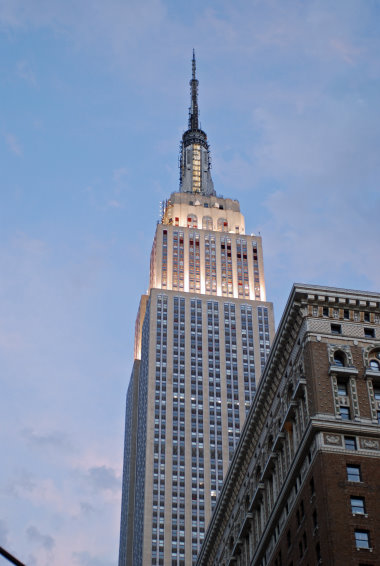
Empire State Building

Deutlich mehr fasziniert hat mich allerdings der Art Déco-Stil – wahrscheinlich weil er weniger opulent und verspielter rüberkommt. Und da ist das Empire State Building zwar ein Beispiel dafür, aber nicht unbedingt eines der besten. Daran hat mich die Tatsache fast schockiert, dass es in nur 11 Monaten in 1930-31 hochgezogen wurde. Mindestens so lange ist die Baustelle am Friedensplatz schon ein Loch, wo zwar irgendwie Aktivität herrscht, aber (scheinbar) nichts passiert…

I was decidedly more fascinated by the Art Déco style – probably because it felt less opulent and more playful. The Empire State Building is an example for that style, though not the most impressive. I was just shocked that it took a mere 11 months to build in 1930-31. A construction site here in Bonn has been a hole in the ground for about as long, with some activity going on but where nothing seems to happen…

Chrysler Building

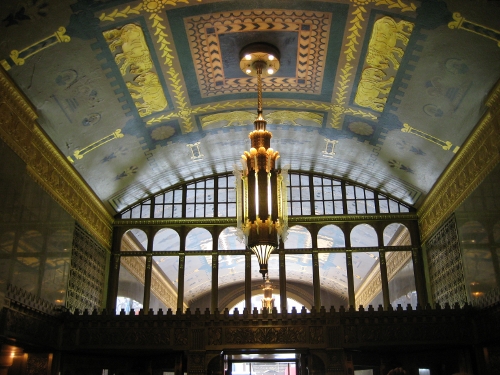
Das Chrysler Building mit seiner glänzenden Stahlspitze gehört wohl zu den Gebäuden, die mir am besten gefallen haben. Die Lobby war frei zugänglich (in andere sind wir einfach mal eingefallen, nach dem Motto, dass man ja immer noch rausgeschmissen werden kann).

The Chrysler Building with its gleaming steel top is definitely among those that I liked best. The lobby was open to the public (others, which were not really, were simply invaded politely – the motto being that we might as well try).

Oben / Above: Deckengemälde / Ceiling fresco (Chrysler Building)
Unten / Below: Aufzüge / Elevators (General Electric Building)

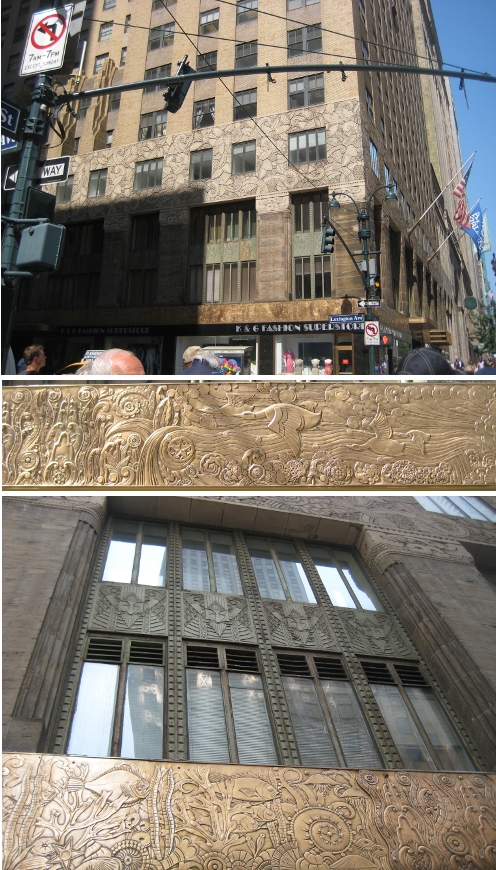
Interessant (und wenn nicht verspielt, was dann?) auch das Chanin Building:

It’s no exaggeration to say that the Chanin Building was interesting (and playful, if anything!):

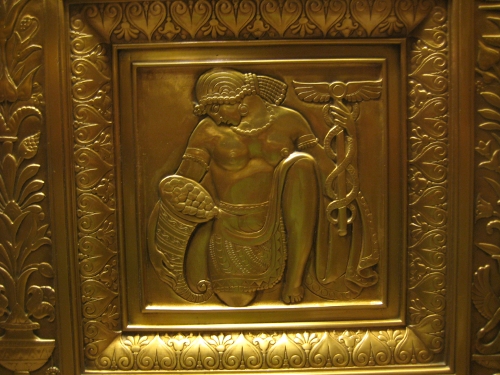
Eine farbenfrohe und detailverliebte Lobby auch im Fred F. French Building (links Detail einer von vielen Aufzugtüren):

A colorful lobby featuring attention to detail was to be found at the Fred F. French Building (detail of one of the many elevator doors at left):

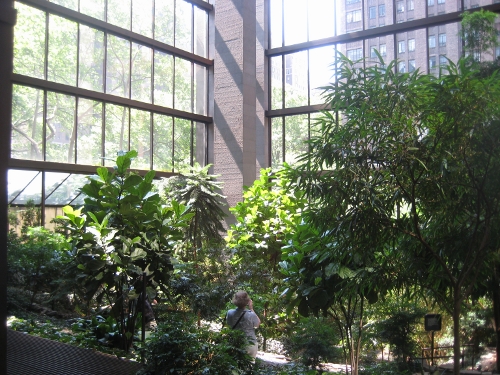
Ein Beispiel für den International Style ist das Gebäude der Ford Foundation, das erfolgreich öffentliche und private Räume verbindet. Büroräume an zwei Seiten umgeben einen (Winter-)Garten.

The Ford Foundation Building is an example of the International Style. It successfully fuses public and private spaces. Office space in two wings is met by a (winter) garden.

Ford Foundation Building (1967)

Das aus 21 Gebäuden bestehende Rockefeller Center hat nicht direkt den Weg in mein Herz gefunden…

The 21 building strong Rockefeller Center did not win my heart right away…

Rockefeller Center (1931-40)

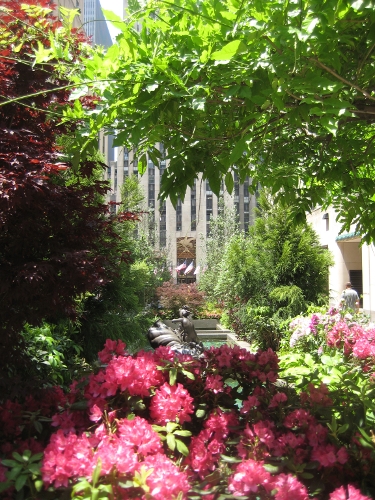
… aber es ist nur eine Frage der Perspektive! 😉

… but it’s all a matter of perspective! 😉

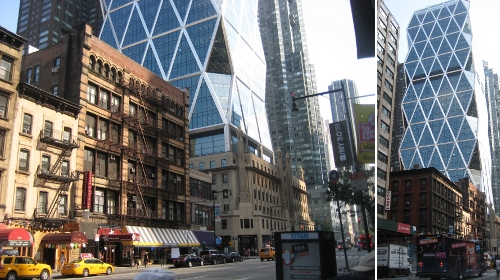
Zum Abschluss noch ein Blick auf zwei sehr neue Gebäude: auf den Hearst Tower von Norman Foster – man beachte das alte „Fundament“…

And now let’s have a last look at two more and rather recent buildings: the Hearst Tower by Norman Foster – note the old „base“…

Hearst Tower (2003-06)

… und das New Museum der japanischen Architekten Sejima und Nishizawa (2004-07):

… and the New Museum of Japanese architects Sejima and Nishizawa (2004-07):

So, und nun erlaube ich mir, zusammenzubrechen. Ich denke, ich habe noch keinen Eintrag geschrieben, der mehr Links enthielt, als dieser… viel Spaß damit! Gute Nacht, liebe Freunde!

With this, I am going to crash. I don’t think I’ve ever written a post with more links in it than this one… enjoy! Good night, dear friends!

Barbara