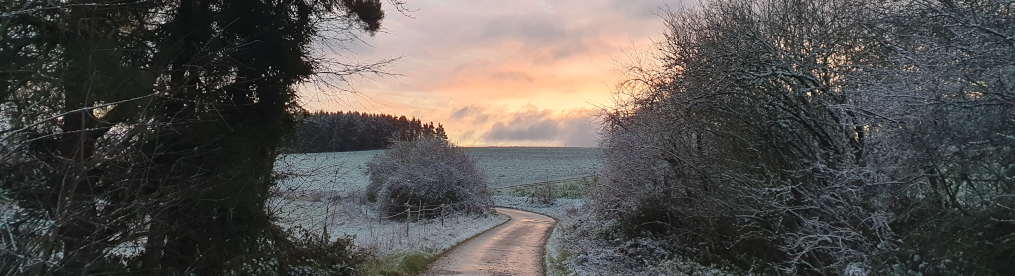

Was für eine Aufgabe: eine superintensive Woche und etwa 1000 Fotos auf ein paar Beiträge runterdampfen, die sich noch halbwegs flüssig lesen lassen… Wieder einmal wusste ich nicht, worauf ich mich eingelassen hatte. Jo, Bildungsurlaub. Ach, warum nicht Breslau, da kannst du dann Jadwiga besuchen. Noch nie in Polen gewesen. Und jetzt ein klitzekleines bisschen angefixt.
What a task ahead: trying to reduce a superintense week and about 1,000 photos into a few posts that ideally are also somewhat plesant to read… Once again, I had no idea what I had gotten myself into. Sure, educational leave („Bildungsurlaub“, a concept in Germany that allows for 5 extra leave days a year that you can spend to „broaden your horizon“, basically). Okay, why not Wroclaw – I can also meet Jadwiga for a coffee while I’m there. Never been to Poland before. And now maybe just a tad hooked.

Schon am Vortag angereist, mit einem Hotel so richtig mittendrin, bin ich kopfüber rein und war erstmal auf einem 70. Geburtstag eingeladen, bei, so kann mal wohl sagen, einer Freudin der Familie, die einige Zeit die Betreuungskraft meines Vaters war. Das war schonmal ein wunderschöner Abend mit viel leckerem Essen und einigem Wodka. Und viel Namen lernen. Der Morgen danach war dann „slow“, aber gerade aus dem Hotel raus bin ich quasi schon auf den Großen Marktplatz gefallen und stellte offenen Mundes fest: wer den nicht kennt, weiß nicht, was ein großer Marktplatz ist. Nun lernte ich zwar keine 24 Stunden später, dass der in Krakau größer ist… aber nicht ganz so alt.
I traveled to Wroclaw a day early, stayed in a hotel smack in the middle of it all, and dived right into everything by attending the 70th birthday party of my late Dad’s live-in help who turned into a family friend. That was an excellent start, a wonderful evening with lots of yummy food and some more vodka. And a lot of time spent memorizing names. The morning after was a bit slow but only few steps away from the hotel I found the Grand Market Square, and, mouth agape, thought to myself that you have never seen a Grand Market Square if you haven’t seen this one. Less than 24 hours later I heard that the one in Krakow is even larger – but not quite as old.

Nun muss man sagen, dass diese Häuser fast alle nicht original sind und auch als Wiederaufbau einige künstlerischen Freiheiten der Architekten aufweisen, aber die Atmosphäre stimmt wohl, wenn man vergleicht mit den überall erhältlichen Postkarten mit Motiven von vor dem Zweiten Weltkrieg. Das Schicksal von Breslau, einer pulsierenden Metropole und drittgrößte Stadt des damaligen Deutschland, kann einen nochmal extra fertigmachen, denn bis Ende 1944 war hier kriegstechnisch nicht viel los. Dann wurde die Tatsache, dass sie zur „Festung“ erklärt wurde, der nicht befestigten Stadt zum Verhängnis und in den allerletzten Monaten des Krieges wurde sie zu 70% zerstört, inkl. einer wahnwitzigen Schneise, die durch Wohnbebauung, Kirchen und anderes gesprengt wurde, um eine innerstädtische Landebahn zu schaffen. Wenig hilfreich für die Bevölkerung war auch, dass aus der Riege der kranken Größenwahnsinnigen hier auch noch jemand am Ruder war, der die Evakuierung der Stadt erst dann als sinnvoll erachtete, als das nur noch zu Fuß möglich war, weil die herannahende russische Armee die Stadt im Prinzip schon eingekesselt hatte. Bei -20°C im Februar 1945 sind Tausende dabei erfroren. Das Resultat des Wiederaufbaus, der soviel wiederhergestellt hat, hat mich echt beeindruckt… es muss halt nicht aussehen wie Köln.
Admittedly, most of the houses are not exactly original and the architects tapped artistic freedom sometimes more, sometimes less. But the general character of the square seems to be intact if you compare today’s look with pre-WWII postcards that you can buy on every corner. Wroclaw, then Breslau, was a true metropolis of the time, third largest city in what was then Germany, and its fate hits twice as hard when you realize that there hadn’t been much of a war here until the end of 1944. But the fact that it was declared a „fortress“ sealed its fate and 70% of the practically unfortified city were destroyed in the very last months of the war. Part of the insane actions was the creation of a runway; houses and churches that stood in the way were just blasted away. To add to the plight of the city and its population, the guy representing the bunch of sick megalomaniacs here in Wroclaw decided on an evacuation when it was way too late and the only option left was to leave on foot when the Russian forces had basically surrounded the city already. Thousands lost their lives trying, in temperatures below -20°C. The result of the reconstruction really blew me away… it doesn’t have to look like Cologne after all.

Und dann denkt man sich: ach, den furchtbaren Kasten an der Ecke (von dem ich nun noch nicht mal ein ordentliches Foto habe) hätten sie dann aber doch auch schöner wieder aufbauen können… und erfährt dann, dass das 1929-31 gebaut wurde – drei Bürgerhäuser wurden dafür abgerissen. Die Pfeiler am Eingang sind mit damals hippen ägyptischen Motiven versehen… wer genauer hinsieht, findet Telefone, Haustiere, einen Globus und vieles mehr: ein Bankgebäude versehen mit eingebauter Werbung für all das, was möglich ist, wenn man Geld hat.
And then you think: well, why didn’t they think of something nicer to build on that corner (turns out I don’t even have a decent picture!)… and are told that this is in fact original and from 1929-31 – three of the others were torn down to build this. The pillars at the entrance all feature fake Egyptian scenes – all things Egypt were en vogue at the time and if you look closely, you will find telephones, pets, a globe and much more: it was and still is a bank, with built-in ads for their products, telling you of all the things you can afford if you let experts handle your money.

In der Mitte des Marktplatzes stehen drei Gebäudereihen, ehemalige Tuchhallen, und das alte Rathaus aus dem 13. Jahrhundert (Fertigstellung im 16. Jahrhundert) – das die gewaltsame Einnahme der Stadt quasi unbeschädigt überstanden hatte. Allein der Marktplatz mit allem drum und dran kann einen sicher einen Tag oder länger beschäftigen, angefangen bei den Patrizierhäusern auf der Westseite (oberstes Foto der ersten Kollage), die immer mal wieder als einen Art AirBnB für adligen Besuch herhielten, dem Museum von Pan Tadeusz, dem Nationalepos Polens, oder dem Museum für Bürgerliche Kunst im Alten Rathaus.
There are three rows of buildings in the center of the market square, former „cloth halls“ (if that makes sense) and the Old Town Hall from the 13th century (finished in the 16th century) – it made it through the violent capture of the city largely intact. The market square alone could easily keep you busy for a day or more, starting with the Patrician houses on the west side (top photo in the first collage) which were used AirBnB style for royal visitors, the Museum of Pan Tadeusz, Poland’s national epic, or the Museum for the Art of the Citizens in the Old Townhall.
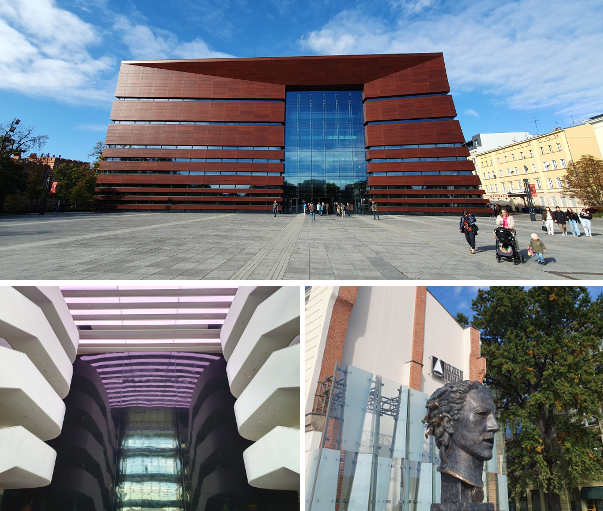
Stilistisch aus einer vollkommen anderen, da viel moderneren Ecke kommt das Nationale Forum der Musik daher, erbaut zwischen 2009-2015. Farben spielen hier eine große Rolle: das Braun steht für die Holzblas- und Streichinstrumente, das (hier an der Fassade nicht sichtbare) Gold symbolisiert die Blechblasinstrumente und die Gestaltung im Innenraum soll an eine Klaviertastatur erinnern.
The National Forum of Music is a whole different story – built between 2009 and 2015 it’s a modern structure where colors play important roles: brown symbolizes woodwind and string instruments, the golden part of the facade (not visible on my picture) stands for the brass instruments and the design of the interior is to evoke a piano keyboard.

Neben der Oder und der Olau sowie ihren Verzweigungen gibt es auch den Stadtgraben – man kann hier ausgiebig am Wasser spazieren, sowas wie 150 Brücken überqueren und diverse Inseln aufsuchen. Im Königlichen Schloss, bzw. dem noch davon erhaltene Kern (in der Kollage oben – es hat allerdings noch Seitenflügel), gibt es eine Ausstellung zu 1000 Jahre Breslau. Nicht falsch verstehen: auch die habe ich nicht gesehen, denn das Programm, Bildungsurlaub wie privat, war echt eng getaktet. Und dann muss es ja dazu auch noch quasi einen Blizzard geben, bevor ich mich von städtischen Erkundungstouren in Museen begebe….
In addition to the Odra and Olawa rivers and their side branches, there is also the city moat – you can walk by the water for hours on end, cross about 150 bridges and check out a number of islands. The Royal Palace, or its core that’s still standing (see collage above – it’s a bit larger though, with two wings), houses an exhibition on 1,000 years of Wroclaw’s history. Don’t get me wrong: I did not see that one, either, as the schedule, both for the study trip and the socializing components, was packed. Add to that my preference for urban excursions over museums so that it basically takes a blizzard to keep me indoors…
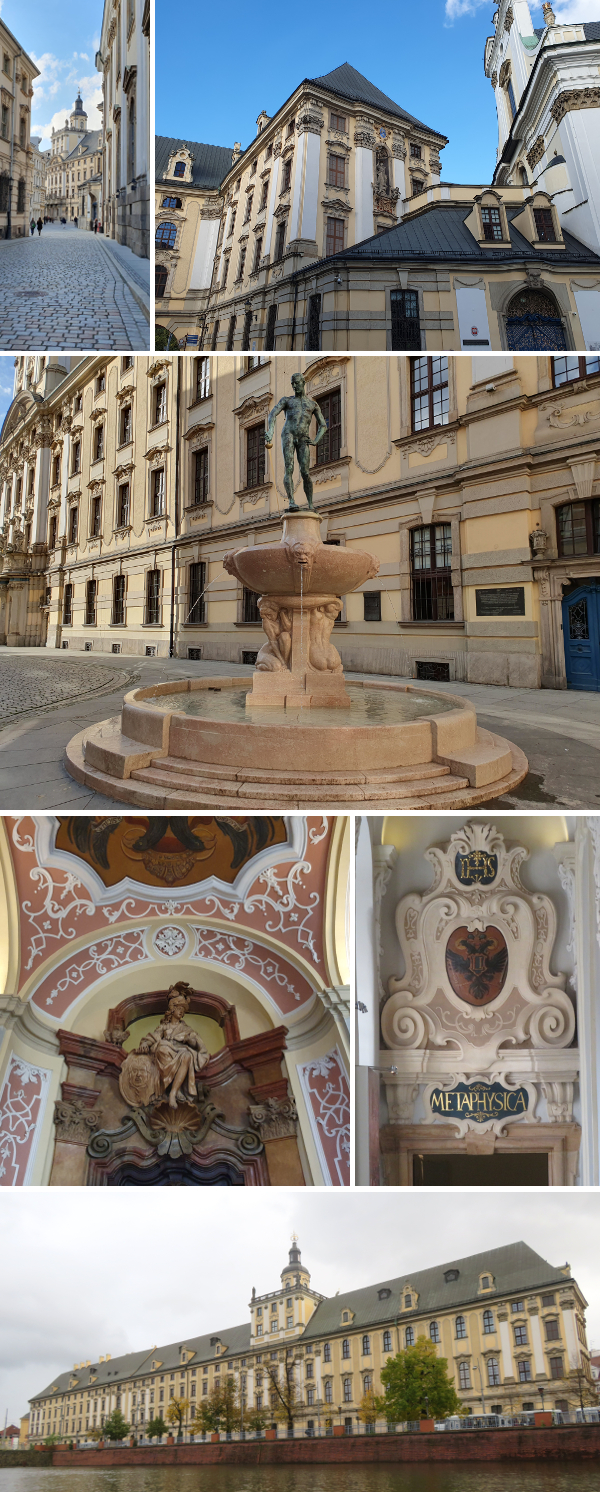
Zum Ende des ersten Tages erreichten wir dann noch die Universität – Breslau hat etwa 140.000 Studierende an mehrere Hochschulen. Das vermittelt vielleicht schon ein bisschen eine Idee, wie die Stadt so „ist.“ An der Stelle einer mittelalterlichen Burg ab 1728 erreichtet, misst die Front 171 Meter – aber das ganze kleine „Uni-Viertel“ ist sehr malerisch. Denkst du schon so und dann betrittst du das Oratorium Marianum – im Zweiten Weltkrieg komplett zerstört und erst durch die kürzlich wieder rekonstruierten Deckengemälde vollständig wiederaufgebaut. Inklusive des eingebauten Selbstportraits des ursprünglichen Künstlers (rechts unten).
Towards the end of the first day we reached the university – there are about 140,000 students at a number of different universities in Wroclaw. Maybe that gives you an idea of what the city is like. The building, with its 171-meter front, was erected from 1728 onwards on the place of a medieval castle – but the whole „university neighborhood“ is really picturesque. That’s what I thought anyway, even before we got to Oratorium Marianum – completely gone after WWII and fully restored only recently when the ceilings were returned to former glory as well. Including the self-portrait of the original artist (lower right).

Und dann gehst du in den ersten Stock und das nächste Highlight wartet schon: die Aula Leopoldina, benannt nach dem österreichischen Kaiser Leopold I., der auch zentral zur Geltung kommt, umrahmt von einer Frau mit Bienenstock (Fleiß und Wirtschaftlichkeit) und einem Mann mit Spiegel und Herz (Klugheit und Wahrheit). Wie auch im Oratorium Marianum kann man hier stundenlang sitzen und sich mit den Details beschäftigen. Auf jeden Fall gibt es in solchem Ambiente stilvolle Semestereröffnungsveranstaltungen!
And then you walk up a flight of stairs and face the next highlight, Aula Leopoldina, named after the Austrian emperor Leopold I., centrally staged alongside a woman with a beehive (hard work and efficiency) and a man with a mirror and a heart (smartness and truth). As in the Oratorium Marianum, you can spend hours just sitting here and looking at the endless details. It certainly is a stylish place to attend an opening event for a new academic year!

Den Turm des Gebäudes kann man auch besteigen, kommt dabei durch ein kleines astronomisches Museum, und hat dann einen schönen Blick in alle Richtungen – auch auf die nicht von allen geschätzte vielgeschossige neue Uferbebauung.
You can climb the tower of the building, too, accessing a small museum of astronomy while doing so, and are treated to a wonderful view in all directions – also towards the new highrises on the water front that are not appreciated by all.

Soviel zu Tag 1 – der so viel mehr beinhaltete, aber dafür müsst ihr die Reise dann selbst antreten, „Breslau. Aus Breslau wird Wroclaw – Eine europäische Stadt erfindet sich neu“ beim Forum Unna. Es folgen hoffentlich weitere Beiträge…
So much for day 1 – which was so much more but I guess you have to do the trip yourselves, self-organized or via „Breslau becomes Wroclaw – A European City reinvents itself“ of Forum Unna. More posts to follow, hopefully.
Barbara
 The Knackered Grouse
Wow!
Day 1
A very ‘packed’ day!
Great pictures, and awesome narrative!
LikeLike
Mega interessant!!!!!!
LikeLike
Hallo Babsi, schön von dir wieder einen Reisebericht zu sehen. Ich war in Krakau und Warschau. Wunderschön und vor allen Dingen sehr sauber überall. Hoffe es geht dir gut wie uns, alles Liebe Ulla
LikeLike
Thanks for the re-visit to one of my favorite cities in Poland. Sounds like you fit in a lot of activities and sites. Good for you! Keep having a good time! Thanks for sharing.
LikeLike